Aalto's Buildings Just Made World Heritage Status—So Why Might Finland Lock Them Up?
Unesco has named 13 Alvar Aalto buildings World Heritage sites, sparking national celebration in Finland. But questions over restoration budgets, public access and preservation rules are turning that honour into a heavy burden.
Step inside the National Pensions Institute Headquarters (Kela HQ) in Helsinki, and the red-brick façade and copper eaves are all still there. But walk into the lobby and it's clear this building needs more than a cosmetic touch-up—officials estimate restoration costs at between €130 million and €170 million. It's the heaviest inheritance Alvar Aalto, Aino Aalto and Elissa Aalto left behind for Finland.
Unesco has just added "Aalto Works"—13 signature Alvar Aalto sites spread across Finland—to its World Heritage list, and the country is celebrating, viewing it as a fresh engine for tourism and regional investment. But beneath the accolade lurks a question: is freezing in place a set of spaces that were originally designed to evolve alongside society really what the Aalto family would have wanted?
Money is the first hurdle. By signing the World Heritage Convention, Finland is now legally obligated to maintain these buildings—but Unesco offers international prestige, not funding. The Finnish government is tightening public spending and is unlikely to foot the bill, leaving private foundations as the last hope. Relying on philanthropy to plug a gap worth hundreds of millions of euros has never been a safe bet. The Church of the Three Crosses in Imatra has suffered serious moisture damage, with parts of it already closed off for safety reasons. This isn't a problem unique to Aalto's buildings, but the World Heritage title makes it much harder to ignore.
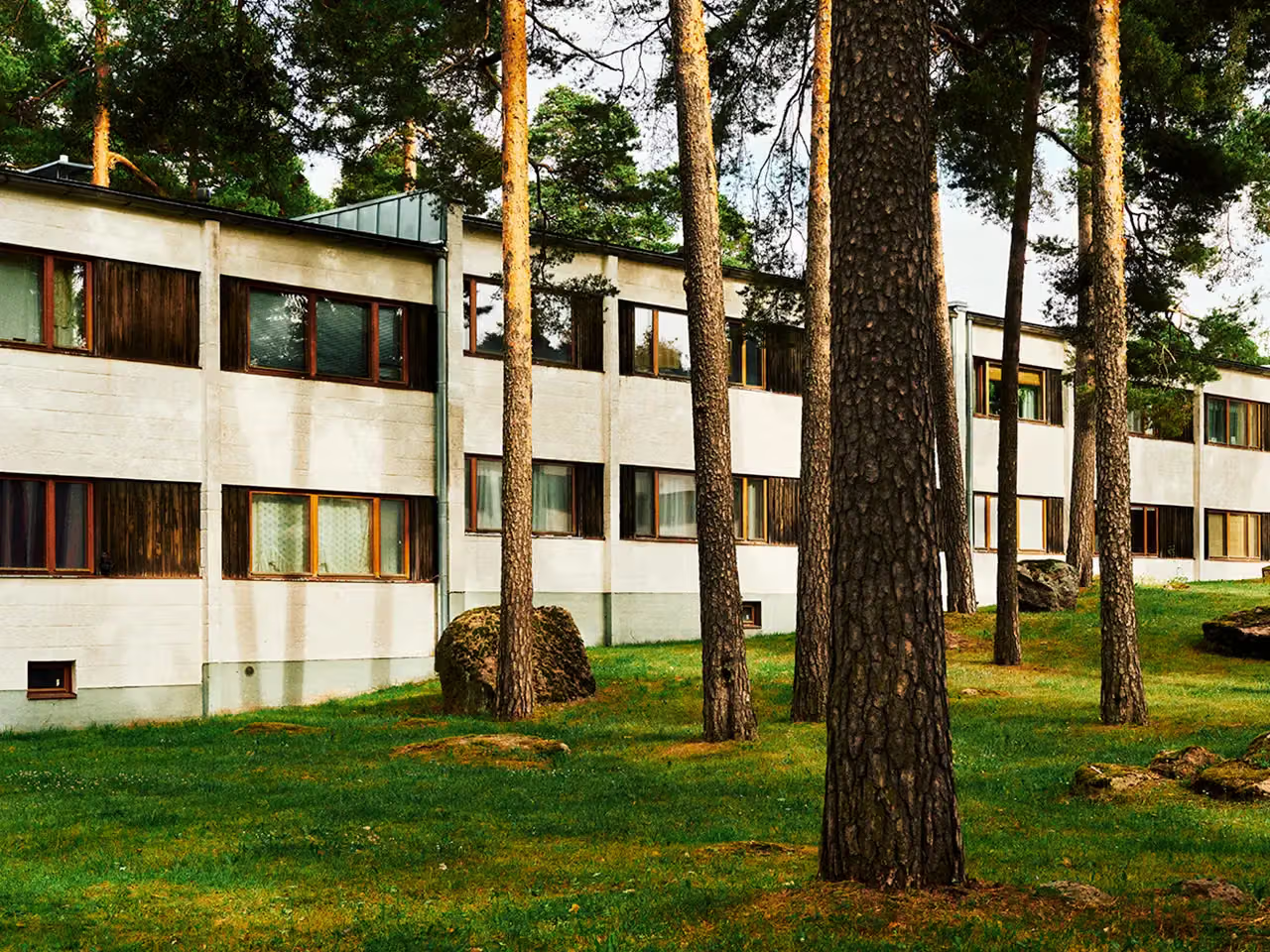
Even more awkward than the money is the question of access. The Aalto studio's core belief was that architecture should be open to everyone, yet many of the newly listed sites are simply off-limits to ordinary visitors. Kela HQ remains an active office for Finland's social insurance agency and isn't open to the public—unless you happen to be a Monocle correspondent who can pull strings for a private tour. The staff housing at Sunila Pulp Mill in Kotka is a genuine lived-in community, and residents have no obligation to welcome tourists peering through their windows, even if this happens to be one of the happiest countries on earth. As for Muuratsalo Experimental House on a small island near Jyväskylä, it's only reachable by guided boat tour during a brief window each summer.
Unesco doesn't actually require every heritage site to throw open its doors—it only asks host countries to "present and promote" them. Finland's policy circles have pragmatically interpreted this to mean letting people walk up to a building's perimeter and take in the façade. That may satisfy the letter of the convention, but it hardly does justice to Aalto's original intent—Villa Mairea in Noormarkku proves the family designed complete environments, where custom interior lighting and furniture mattered just as much as the lawn and pool outside. Seeing only the exterior means seeing only half the picture.
The deeper contradiction lies in preservation itself. The buildings the Aalto family designed were meant to change shape alongside their users and the times. Unesco has loosened its stance on "adaptive reuse" in recent years, but listed buildings are still required to retain their original materials, techniques and composition—an awkward straitjacket for structures that were, by design, meant to be transformed. Snøhetta's master plan for Paimio Sanatorium, which attempts to balance healthcare functionality with preservation rules, is currently the most ambitious effort of its kind—but keeping the rules from turning these once-radical living spaces into museum pieces is no easy task.
Monocle's Helsinki correspondent Petri Burtsoff puts it bluntly: Unesco recognition should be the starting point for Finland to care for these buildings actively and imaginatively—not the end of the story. If all 13 sites end up displayed behind velvet ropes like museum exhibits, that would be the real betrayal of the practicality Aalto championed all along.