This bunker was originally built to stop tanks. Thick concrete, sealed shut, impact-resistant—Seoul's Cold War-era anti-tank bunker, the Peace Culture Bunker, now holds the memory of a fishing boat, courtesy of artist Checksy Choi. Her exhibition Eotieum: The Ply of Longing occupies two chambers of the bunker plus the connecting corridor, taking as its starting point the fishing boat her grandmother boarded to flee North Korea during the Korean War. Rather than reconstructing the boat itself, Choi breaks it down into a concept she calls "Eotieum" (엇이음): dislocation isn't a failure of connection, but the very condition under which relationships continue to exist. The project began shortly after her grandmother's passing—she had originally hoped to see the finished exhibition with her own eyes.
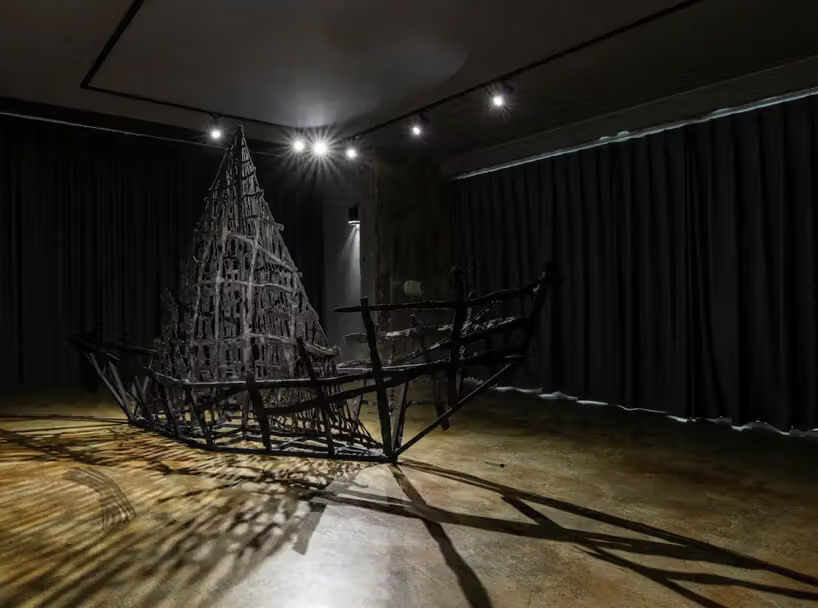
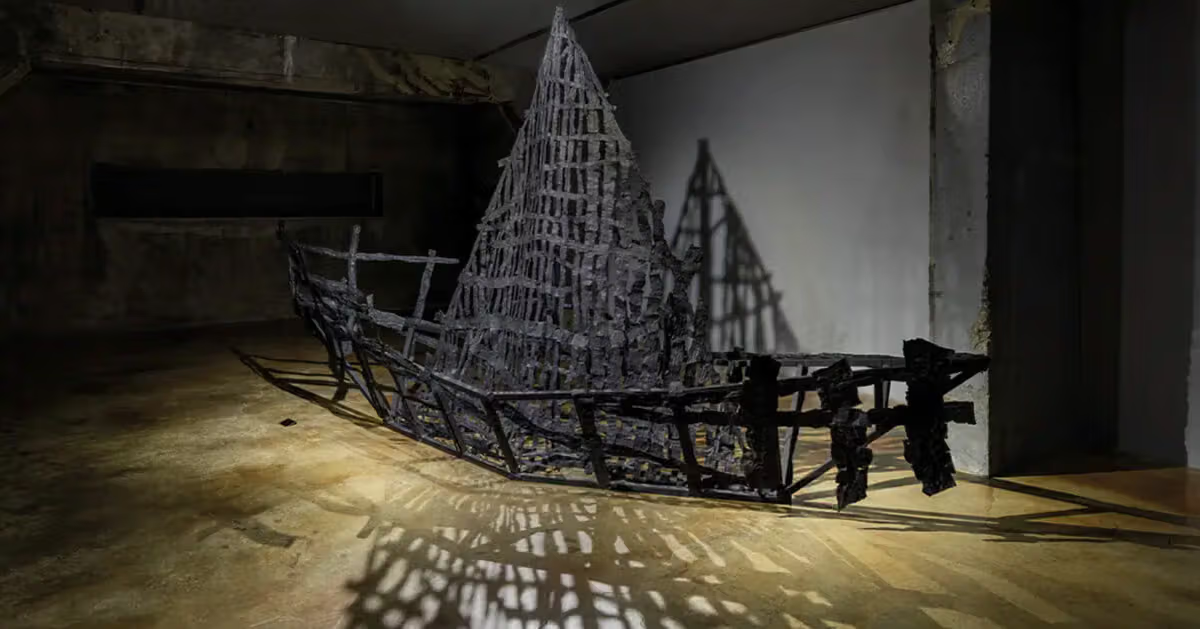
In the first chamber, Eotieum Vessel—430cm long, 220cm wide, 110cm tall—anchors the entire show. A welded steel frame is covered in thousands of hand-torn hanji paper fragments, rearranged into "Gyeokja" (격자), a lattice vocabulary Choi developed from traditional Korean wooden lattice windows. The form is deliberately porous, letting light, air, humidity, and visitors' movement pass through its surface, casting ever-shifting shadows across the walls and floor as conditions change—less a fixed sculpture than a container that breathes.
A Boat in the Corridor, an Embrace Behind the Fence
In the connecting corridor, You May Pull the Vessel features a small hanji-paper boat tethered by hemp rope. Before the opening, Choi herself pulled the boat through this corridor; afterward, visitors take over the same gesture. The boat leaves no permanent trace, but the act itself continues to be passed on through sound, memory, and repetition.