ÉTAT HER

Britain and America Love "Summer Fridays," But France Already Locked In a Whole August by Law

Leaving the office two hours early on Fridays and disappearing from the office for an entire month were never the same kind of break. France has legislated the right to disconnect to protect off-hours, and Emily Bryce-Perkins uses this to ask Britain and America: can you get used to the idea that the world keeps turning in August without you?

Tzu-Han Chou, Travel Editor
Britain and America Love "Summer Fridays," But France Already Locked In a Whole August by Law

Every August, much of continental Europe simply pulls down the shutters. People go home to family and friends, and the whole country seems to hit pause together. It happens every single year, yet it still leaves people in British and American workplaces a little uneasy—not exactly envy, more a hard-to-pin-down irritation: how exactly do you get to arrange a whole month like this?

Meanwhile, the best thing British and American offices can offer up for comparison is the so-called "Summer Fridays": leaving the office early, usually around 3pm, or a little earlier if you're lucky. That's not a bad thing in itself, but put "taking the whole month of August off" next to "leaving an hour or two early on Fridays," and the gap speaks for itself.

France's approach isn't built on vibes—it's built on law. Since 2017, France's droit à la déconnexion (right to disconnect) has required companies above a certain size to negotiate formal policies with employees, spelling out clear boundaries on after-hours contact. The law is blunt about it: your off-hours don't belong to the company. Hands off.

Once you lay it out this way, it becomes clear the real issue was never the policy wording—it's trust. It comes down to whether a country is willing to trust its own citizens not to fall apart the moment they're on holiday. France and Italy have chosen to treat rest as something that needs protecting; Britain and America tend to treat rest as something slightly embarrassing, something to be handled quietly.

London-based writer and Monocle contributor Emily Bryce-Perkins points out that everyone loves European plazas, cafés, and long lunches, but rarely stops to think about what makes those scenes possible in the first place: a society has to collectively agree that success doesn't mean being on call all the time. She admits not every company can actually shut down for a full month—nor should they all try to—but what she's really asking is whether Britain and America can get comfortable with the idea that the world keeps running just fine in August, office or no office.

The piece ends with a proposal that's only half joking: if there's ever a chance for Britain and Europe to grow closer again, what she'd really want in return isn't just another trade deal—it's something like an "August Accord."


Related

Anthony Boyle Transforms Into Sam Bankman-Fried as Netflix Teases "The Altruists"
Living

Anthony Boyle Transforms Into Sam Bankman-Fried as Netflix Teases "The Altruists"

The streaming giant's new 8-episode series reconstructs the FTX implosion, tracing the bond between Sam Bankman-Fried and Caroline Ellison that unraveled alongside the crypto empire. Streaming begins November 19.

TikTok Ads Shut Out Entirely by Meta — Beneath the "Routine Business" Label Lies a Fight Over Child Safety
Living

TikTok Ads Shut Out Entirely by Meta — Beneath the "Routine Business" Label Lies a Fight Over Child Safety

Meta has barred ByteDance, TikTok's parent company, from running ads in seven countries, framing the move as "normal business behavior" since companies aren't obligated to promote rivals — a decision arriving just after Meta itself shelled out $1.8 billion to settle a child safety lawsuit.

New Anthropic Policy Bars "Prolonged, Gratuitous Abuse" of AI Models, With Election Rules Also Tightened
Living

New Anthropic Policy Bars "Prolonged, Gratuitous Abuse" of AI Models, With Election Rules Also Tightened

In its annual usage policy update, Anthropic introduced a clause prohibiting users from inflicting "prolonged and gratuitous" abuse on Claude and other models, while election-related rules were also tightened—sparking renewed debate over whether AI should be regarded as a sentient subject.

A "Paper-Like" Screen Built with Corning Etching Tech Debuts on Amazon's 12-Inch Alexa+ Pro Tablet
Living

A "Paper-Like" Screen Built with Corning Etching Tech Debuts on Amazon's 12-Inch Alexa+ Pro Tablet

The flagship 12 Pro showcases a Nanomatte etched display co-developed with Corning, as Amazon rolls out three new Alexa+ tablets—12-inch, 11-inch, and 8-inch models. Pricing starts at $230, with availability in the US, Canada, and Mexico beginning October 14.

Microsoft Puts Agentic AI at the Heart of Windows Search as Jensen Huang Looks On and Davuluri Takes the Stage
Living

Microsoft Puts Agentic AI at the Heart of Windows Search as Jensen Huang Looks On and Davuluri Takes the Stage

At a San Francisco event on October 7, Satya Nadella and Pavan Davuluri unveiled Microsoft's Windows and Surface plans while Jensen Huang watched from the audience. The centerpiece is a deeper integration of Copilot into the search bar and local files, set to arrive this fall.

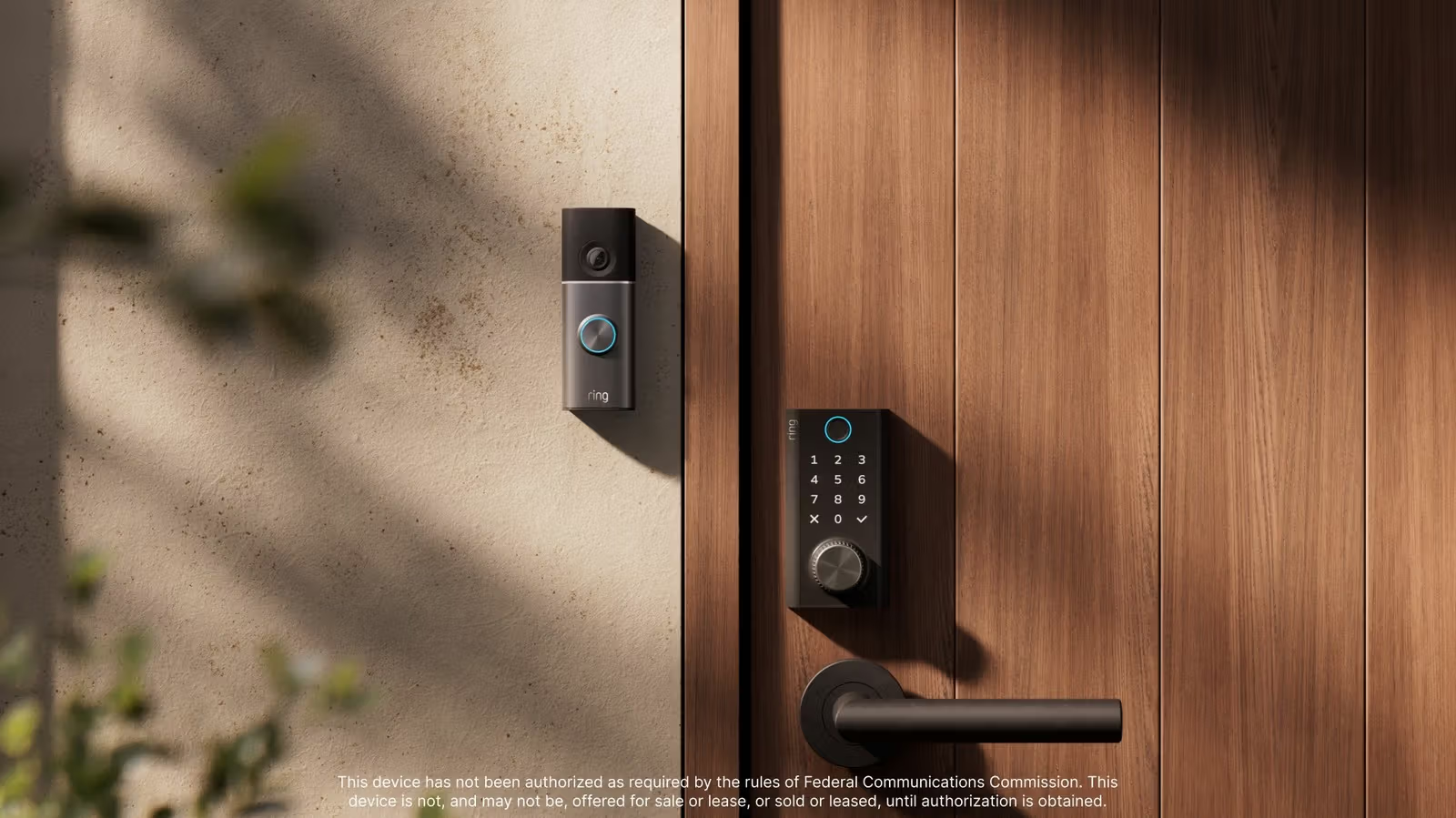
Ring's Fix for Smart Lock Skeptics: A Manual Crank When Power Runs Out
Living

Ring's Fix for Smart Lock Skeptics: A Manual Crank When Power Runs Out

According to Ring founder Jamie Siminoff, fear of dead batteries has long held smart locks back. The company's answer is a hand-crank generator built into its upcoming Smart Lock, letting users turn a handle for emergency entry. Launch is set for early 2027 at $249.