ÉTAT HER

Nine Voices from Recycled PLA: Ninefold Turns 3D-Printing Scrap into a Sound Field That Shifts as You Walk Through It

An architect, a percussionist-composer, and a materials researcher teamed up to 3D-print nine resonant forms from discarded lab PLA — each tuned to a different frequency, so the soundscape you hear shifts depending on where you stand.

Nine Voices from Recycled PLA: Ninefold Turns 3D-Printing Scrap into a Sound Field That Shifts as You Walk Through It

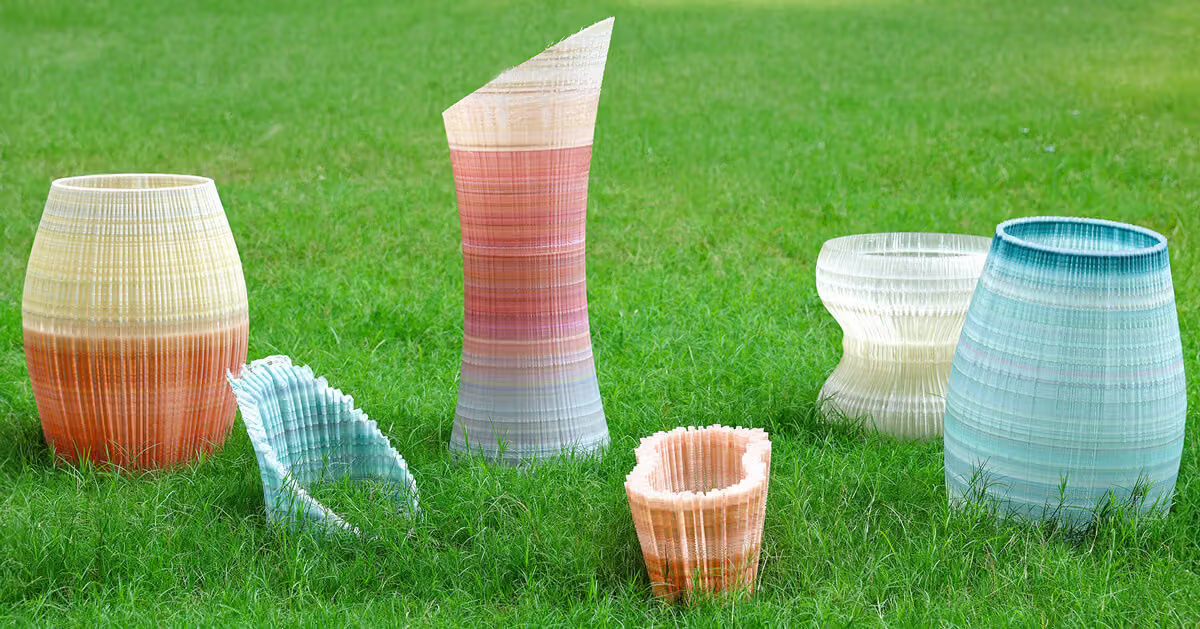
Most "recycled material redesign" projects start by sanding away the seams, bubbles, and color inconsistencies, pretending the material was never discarded in the first place. Ninefold: A Distributed Resonant Field does the opposite: the translucency variations, the interplay of matte and clear surfaces, the layered textures created by mixing and reprinting discarded PLA pellets — all of it stays visible, unpolished. Because that process of being thrown away and reformed is exactly what this piece is about.

The installation is a collaboration between architect Hyojin Kwon (founder of studio Pre- and Post-), percussionist/composer/multimedia artist Jeremy Muller, and architect and materials researcher Misri Patel. The raw material is PLA print waste discarded from a lab, ground into pellets, blended with virgin material, and reprinted into nine large-scale objects via pellet-based additive manufacturing. The three-way collaboration reflects the piece's identity: this isn't simply sculpture, nor simply a sound installation — it's architectural geometry, acoustic tuning, and material research running in parallel.

Nine Objects, Nine Frequencies
Nine Voices from Recycled PLA: Ninefold Turns 3D-Printing Scrap into a Sound Field That Shifts as You Walk Through It

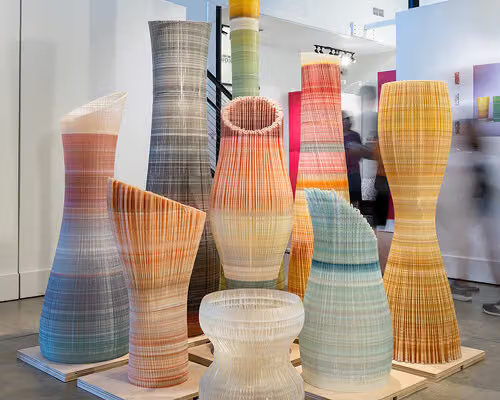
These nine objects aren't nine copies from a single mold. The team used a reaction-diffusion algorithm to generate the forms, letting the shapes expand, contract, twist, and fold on their own — the results range from slender towering columns to pieces that narrow in the middle and flare out into chambers at both ends, each with its own proportions and configuration. More importantly, each piece is tuned to a specific frequency within a harmonic spectrum — functionally, they're resonators, not decoration. Arranged in a 3x3 grid, the sound source is no longer concentrated at a single speaker or point but distributed throughout the entire space. As visitors move to different positions, the combination of resonators they hear and the light-and-geometry relationships they see shift accordingly — meaning no two people walk away from the exhibit with quite the same experience.

Each resonator was built in modular segments and then assembled into a complete structure, an approach that simultaneously solves for transport, maintenance, and future reconfiguration — in other words, these nine pieces can theoretically be disassembled, moved, and rearranged into entirely different formations in another space.

Ninefold is being shown alongside the exhibition "Plastic Reimagined: Material Agency & Circular Design," which explores the application of discarded plastic at architectural scale, encompassing computational design, material experimentation, and large-scale fabrication. Placing the two projects together makes the logic clear: rather than treating plastic waste as a problem to be dealt with, it's treated as a source material capable of generating new geometries, new acoustic properties, and new spatial relationships.

The exhibition runs from July 10, 2026 at the Reeves House Visual Arts Center in Woodstock, Georgia, through September 24. A Night Viewing event on the evening of August 20 will feature a panel discussion with Kwon, Muller, and Patel, followed by a 60-minute live improvised performance by Muller — allowing the nine resonators to be truly "played" once, in a lighting and sound configuration reserved for after hours. The project is supported by the U.S. National Science Foundation's ReCreateIt program, Georgia Tech's Manufacturing Institute, and its schools of architecture and music. Photography by Arsh Khanna.

Related

Freddie Mercury's Yamaha C3 Piano Heading to Auction, Estimated at $528,000
Art

Freddie Mercury's Yamaha C3 Piano Heading to Auction, Estimated at $528,000

The Yamaha grand piano that recorded "The Game" and "Hot Space" at Munich's Musicland Studios will go under the hammer at Propstore, alongside Mercury's studio microphone and handwritten manuscripts.

Kenny Schachter on the Art World's Mess: Stop Complaining, Go Make Something
Art

Kenny Schachter on the Art World's Mess: Stop Complaining, Go Make Something

In a Hypebeast "State of Art" interview, artist, critic, and curator Kenny Schachter uses his three-decade obsession with Paul Thek to make the case for his own signature advice: instead of griping about the art world, just get to work.

Justin Bieber Puts Out Call on X: Wants to Make a SKYLRK Phone
Art

Justin Bieber Puts Out Call on X: Wants to Make a SKYLRK Phone

Justin Bieber took to social media to publicly announce he wants to build a SKYLRK phone, leaving behind a dedicated email address to recruit potential collaborators. The idea surfaced the same week SKYLRK has been rolling out a flurry of footwear and audio products.

Ben Quilty's NYC Debut "Devil/God": Turning Cars Into Phallic Idols, Stitching the Virgin Mary Into Corporal Punishment Leather
Art

Ben Quilty's NYC Debut "Devil/God": Turning Cars Into Phallic Idols, Stitching the Virgin Mary Into Corporal Punishment Leather

Australian painter Ben Quilty will present his solo exhibition "Devil/God" at albertz benda in New York, using thickly layered oil paintings and sculpture to confront masculine idolatry, religious power, and ecological collapse. The show opens October 15, 2026.

Yohei Ogawa Enters Trading Cards for the First Time, "Green Cow Garden" Pop-Up Lands at Hong Kong's BELOWGROUND
Art

Yohei Ogawa Enters Trading Cards for the First Time, "Green Cow Garden" Pop-Up Lands at Hong Kong's BELOWGROUND

Japanese illustrator Yohei Ogawa launches a debut trading card project with 137 designs at Hong Kong's BELOWGROUND, anchored by a 1.4-meter BG Bear statue on site. He also opened up about his own struggles trying to score Pokémon card packs.

Met Museum Displays Oldest Surviving Fragment of the Odyssey, Papyrus Reveals Three Lost Lines
Art

Met Museum Displays Oldest Surviving Fragment of the Odyssey, Papyrus Reveals Three Lost Lines

The Metropolitan Museum of Art has put the oldest surviving Ptolemaic-era papyrus fragment of the Odyssey back on display in Gallery 162. Dating to roughly 285–250 BCE Egypt, the ancient artifact contains three lines of verse not found in today's standard text.