$449 Is the New Starting Price for Ray-Ban Meta Gen 3 — But Does That $70 Premium Over Gen 2 Pay Off?
At Connect 2026, Meta introduced the Ray-Ban Meta Gen 3, featuring modest upgrades to battery life, microphones, and design. Yet since most of its new software features are also rolling out to Gen 2, the $70 price increase raises questions.
If you're just looking at the spec sheet, the Ray-Ban Meta Gen 3 doesn't give you much reason to upgrade — and that's exactly the awkward part. Meta unveiled a whole new lineup of smart glasses at Meta Connect 2026, including its first-ever lens-less model, but the Ray-Ban Meta line is still the flagship. The problem is, most of Gen 3's improvements aren't in the hardware — they're features that have already rolled out over the past year on Ray-Ban Meta Optics and the budget Meta Glasses, now folded into this generation.
Beyond new colors and frame styles, the differences between Gen 3 and Gen 2 really only show up once you dig into the spec details. That's exactly what current Gen 2 owners (who paid $649 and up) — or anyone eyeing the $449 Gen 3 — need to understand before deciding.
One More Hour of Battery, One More Microphone
The most obvious change in Gen 3 is battery life and mic count. On a single charge, it lasts 9 hours — an hour more than Gen 2 — and up to 50 hours with the charging case, versus Gen 2's 48 hours. Compared to the 12-hour battery life Meta promises for the Ray-Ban Meta Audio, this isn't a huge jump, and real-world performance will need to wait for hands-on reviews to confirm.
The mic array grew from five on Gen 2 to six on Gen 3. Meta says the added microphone and redesigned array layout improve background noise suppression during calls and AI interactions, though again, that'll need to be tested in practice. What's more notable is that the new mics enable Gen 3 to capture and record Dolby Atmos spatial audio — a feature Meta says will roll out later in 2026.
Another feature ported over from Optics and Meta Glasses is the action button, which can wake Meta AI, take a photo, or be customized as a shortcut for other Ray-Ban Meta functions. By comparison, Gen 2's capture button is limited to camera functions only.
Slightly Smaller Frames, Plus Two New Styles
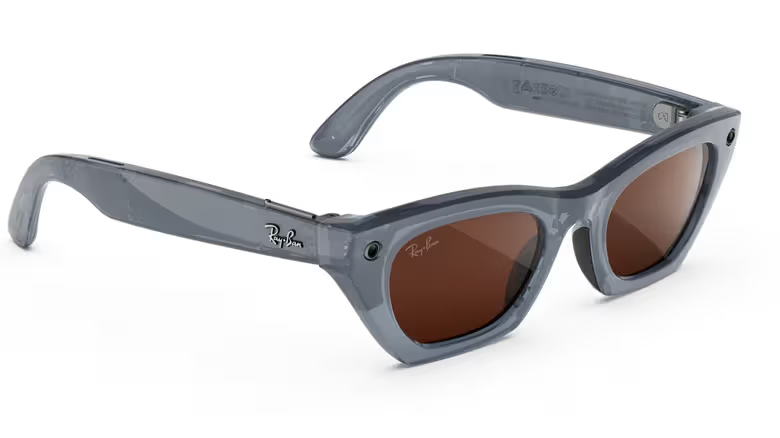
At the end of the day, smart glasses are still glasses, and design differences also set Gen 3 apart from Gen 2. The new Ray-Ban Meta (Gen 3) Aviator features the classic aviator lens shape, available in several translucent and tortoiseshell chunky-frame options, while the Zena has a cat-eye silhouette, offered in translucent, black, and tortoiseshell. So far, the Wayfarer — Ray-Ban's most iconic style — is the only frame carried over from Gen 2.
Using the standard Wayfarer as a benchmark, Gen 2's frame width is 131mm, while Gen 3 shrinks that to 129mm; temple arm length has also been trimmed slightly from 150mm to 149mm. Weight, however, actually went up on Gen 3, at 51.5 grams versus Gen 2's 51 grams. The differences are small enough that you'd barely notice without a side-by-side comparison, but the direction is clear: Meta is trending toward a more compact form factor overall.
Most of the New Features Also Work on Gen 2
The real heart of the Ray-Ban Meta experience is the software and AI, and the vast majority of the new features Meta announced will roll out to Gen 2 owners as well — including the FDA-cleared hearing enhancement feature, interactions with the Muse AI agent, and a burst-photo mode that lets you snap multiple shots and pick the best one afterward.
In other words, that extra $70 for Gen 3 is mostly paying for incremental tweaks to battery, microphones, and design — not an entirely new smart glasses experience. If you don't need prescription lenses, a used Gen 2 pair is likely the better value.