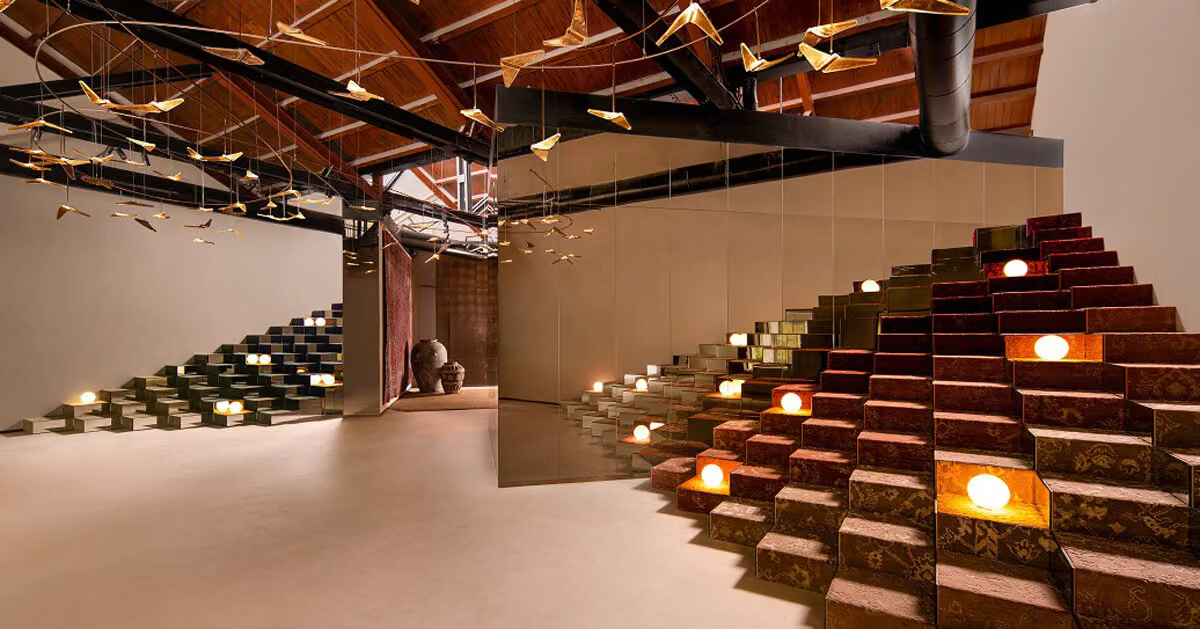
The origin story isn't glamorous: a few Victorian-era steel structural columns stood in the middle of the showroom's circulation path, and they needed to be hidden somehow. Design studio ROAR initially just wanted to find a way to enclose them—but that idea grew into the entire spatial logic of the Jaipur Rugs showroom: a series of cubic volumes, varying in scale, running through the whole old warehouse.
The showroom sits inside the Empire Mills compound in Mumbai's Lower Parel district, formerly a Victorian-era cotton warehouse in Girangaon—the heart of Mumbai's textile industry in the late 19th century, when mills and chimneys lined the streets and earned the city the nickname "Manchester of the East." Today most of these old mills have been converted into cultural or commercial spaces, but traces of their original structure remain. For Jaipur Rugs, a brand built on hand-woven carpets, opening here means placing its handmade heritage at the very source of the city's textile history.
ROAR retained the warehouse's original steel truss roof, pitched form, and clerestory windows, quietly restoring the shell without altering the soaring, open volume inside. The real design work happened entirely within that shell.
A column problem becomes a fractal system
The cubic volumes originally meant to conceal the columns were later scaled up into the spatial language of the entire showroom. They repeat at different scales throughout the space—sometimes as display platforms, sometimes as gallery walls, sometimes as installations with reflective surfaces. This stepped, self-repeating geometry echoes the fractal concept the design team refers to—branching structures like tree limbs or river systems that recur throughout nature, and which also happen to mirror the rhythmic repetition found in the process of hand-knotting and weaving.
This system divides what was once one open warehouse floor plan into several distinct, recognizable zones while maintaining a continuous flow. Flat display walls hold large-format carpets; mesh screen partitions enclose an area where visitors can watch weavers demonstrate their craft; small seating nooks are scattered along the path, where designers and clients can sit and browse through carpets and material samples. One side of the warehouse houses a vertical carpet archive wall with a pull-out, tile-like storage system, turning the storage space itself into part of the visitor experience.
At the entrance, a flock of origami-style metal birds hangs beneath the timber truss, drawing the eye upward and leading visitors into the showroom. A similar folded geometry reappears at a larger scale in the display area, forming reflective installations that continue the visual language set by the birds at the entrance. A separate entrance at the rear of the showroom keeps packing, loading, and staff operations away from the front-of-house display circulation.
Materially, warm timber elements, exposed steel, and reflective surfaces sit alongside hand-woven carpets and traditional weaving tools, giving this industrial old warehouse a backdrop that's neutral without upstaging the space—keeping the carpets themselves as the visual focus. The project was photographed by Avesh Gaur and published by designboom on August 13, 2026, under the title Jaipur Rugs Showroom, Mumbai, designed by ROAR.