Choosing when to go to the office: 44.7% of women in a Japanese survey want control over hybrid-work days
LASSIC's October 30 release covers 1,007 people with remote-work experience. Some 44.7% of women and 32.9% of men wanted to choose office and remote days. These are preferences, not a new employment right or proof that childcare explains the gender gap.
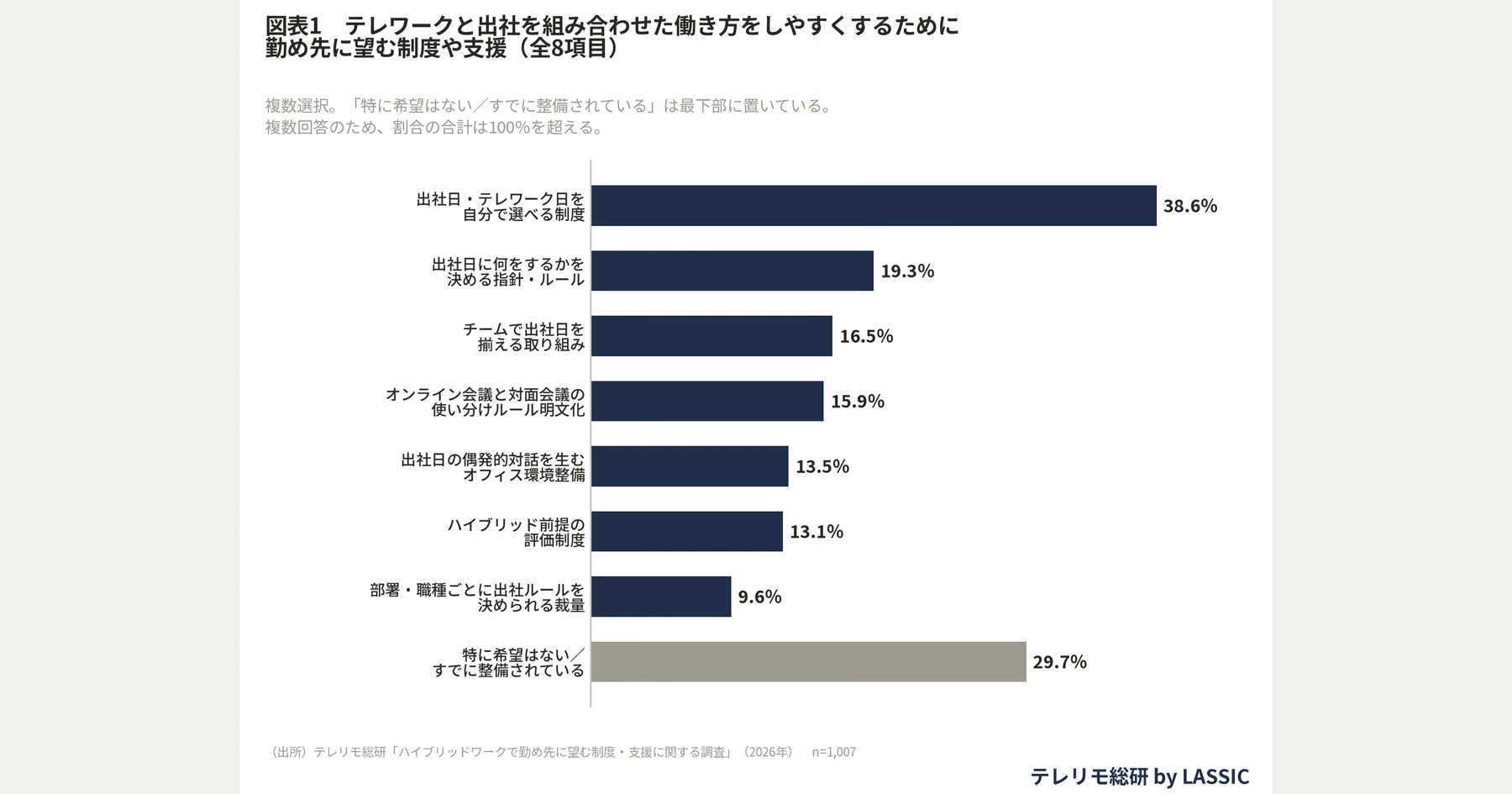
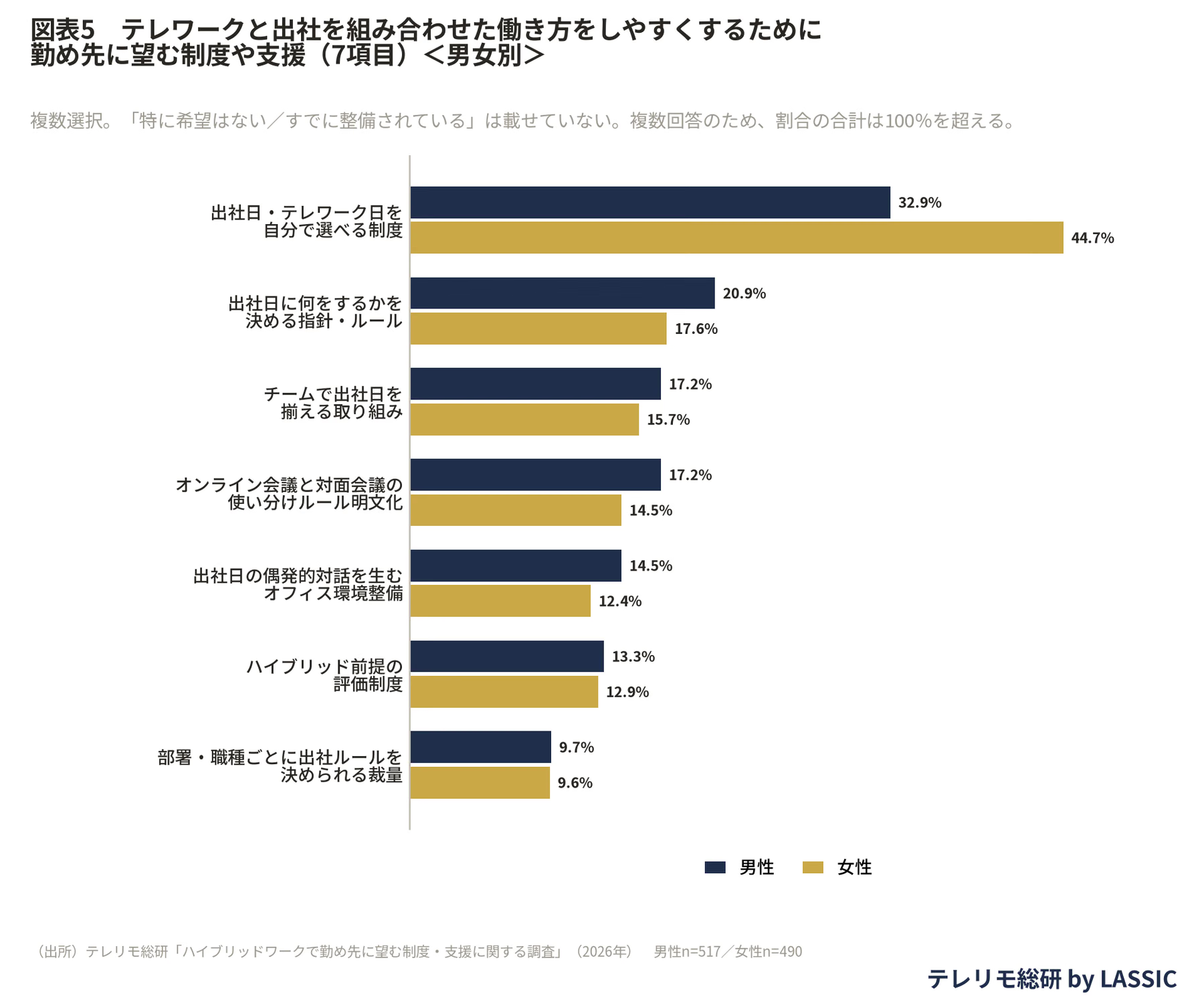
Working the same number of days in an office can feel different when people can choose which days they attend. In a survey released on October 30 by LASSIC's remote-work research team, 38.6% wanted an employer policy allowing them to choose their office and remote days. It was the most selected concrete support measure. Among women the figure was 44.7%, compared with 32.9% among men—a difference of 11.8 percentage points.
The findings do not cover all workers. The online survey ran on September 2–3 among people aged 20–65 in Japan with previous telework or remote-work experience. It received 1,007 valid responses, including 490 women and 517 men. It asks what support people want; it does not announce that their employers already grant this choice, or that employment arrangements in Taiwan have changed.
Flexibility also raises the question of what an office day is for
Respondents could select multiple answers from eight options. Beyond choosing days, selected by 38.6%, some 19.3% wanted guidance or rules determining what to do on office days, and 16.5% wanted the team to coordinate attendance on the same days. These needs can coexist: someone may value personal choice while also wanting colleagues to be present, rather than commuting only to spend the day in online meetings.
Another 29.7% chose the combined option ‘no particular preference/already in place’. That cannot be read as 29.7% being satisfied with existing arrangements, nor does it establish that the remaining 70.3% are dissatisfied. Percentages in this multiple-response question use respondents as the denominator and may total more than 100%; the options do not divide people into eight mutually exclusive camps.
A gender difference does not establish its cause
The difference between 44.7% of women and 32.9% of men is a finding within this sample. The survey does not establish that housework, childcare, commuting safety or any single factor caused it. Assigning one circumstance to all women would obscure differences in jobs and individual needs. Readers may recognise their own experience while leaving room for others to feel differently.
Comparison of multiple responses on hybrid-work support by gender
By current work arrangement, choosing days was selected by 43.0% of hybrid workers, 35.5% of fully remote workers and 34.9% of fully office-based workers—the highest figure among concrete support measures in each group. The groups contained 454, 169 and 384 people respectively. Everyone had remote-work experience, so the office-based group had previously worked remotely; it was not a sample of people who had never done so.
Start the conversation with tasks rather than labels
The survey also asked why people attended the office. Among those whose main purpose was spontaneous interaction and relationship-building, 38.2% wanted guidance for office-day tasks and 31.4% wanted coordinated team attendance. This suggests some respondents care not only about which day they come in, but how collaboration happens once there. It does not mean every employee wants the same attendance days, or demonstrate the effects of a policy already implemented.
For team discussions, one starting point is to identify tasks requiring on-site equipment and collaboration benefiting from face-to-face contact, then consider scope for choice and coordination. This is a discussion prompted by the findings, not a productivity improvement proven by LASSIC. The Japanese data released on October 30 provides a view of workplace expectations; actual company rules and available arrangements still need checking individually.
Questions and answers
Does 44.7% describe all women in Japan?
No. It is the proportion selecting self-chosen office and remote days among the 490 female respondents with remote-work experience. It cannot directly represent all women or workers in Taiwan.
Is the gender gap 11.8% or 11.8 percentage points?
It is 11.8 percentage points: 44.7% minus 32.9%. The gap alone does not establish childcare or another single factor as its cause.
Does this release give employees the right to choose attendance days?
No. It describes respondents' wishes, rather than announcing a new law or an employer policy already in force. Available arrangements depend on applicable rules and company policies.