Zombies Are More Than Monsters: Yeon Sang-ho's 'Colony' Explores Collective vs. Individual
"Train to Busan" director Yeon Sang-ho returns with new film "Colony," set inside a high-rise office building. He talks about why zombie films keep capturing the fears and anxieties of contemporary society.
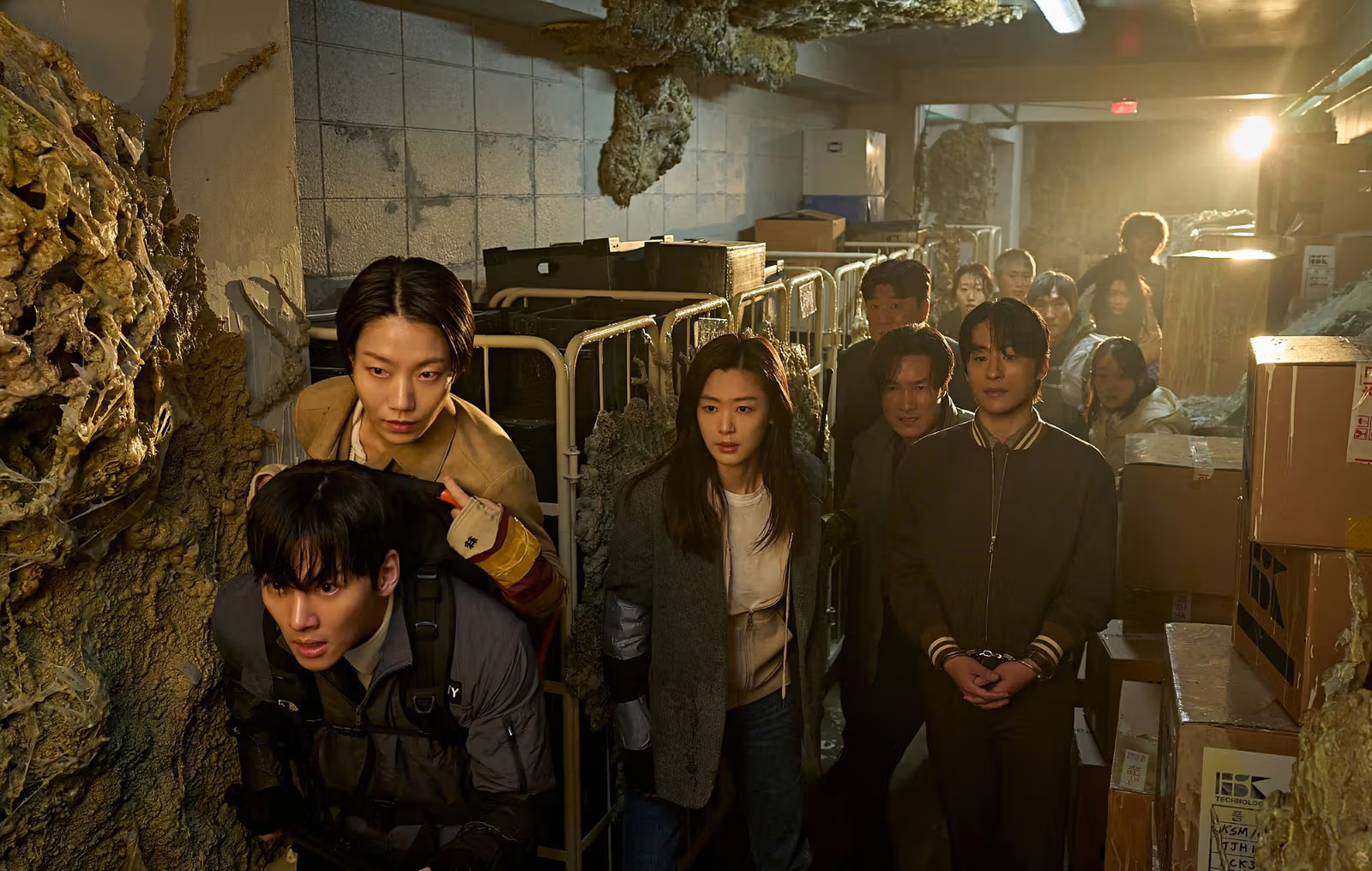
An office building. A bioterror attack. A group of survivors trapped in a vertical space—this is the setting of Yeon Sang-ho's new film "Colony." The South Korean director who made global audiences weep over a zombie film has swapped a speeding train for a stationary tower this time, but what he's really trying to unpack remains the same: to what extent individuals get consumed by the collective under extreme pressure.
In 2016, "Train to Busan" premiered to widespread acclaim at Cannes, placing Yeon Sang-ho among the ranks of South Korean auteurs like Park Chan-wook, Bong Joon-ho, and Na Hong-jin. The film followed Gong Yoo as a workaholic father protecting his daughter (played by Kim Su-an) on a train overrun by zombies, leaving audiences both terrified and in tears. Since then, he's gone on to make the animated prequel "Seoul Station" and the sequel "Peninsula." "Colony" isn't part of that same universe—it's his fourth foray into zombie territory.
"Colony" is set up around a bio-terrorist who releases a pathogen at a science conference, intending to "upgrade" humanity through it. Gu Kyo-hwan, who plays the villain, isn't just a mad scientist—he voluntarily infects himself with the virus, gaining a telepathic-like connection to the zombie horde. Yeon Sang-ho chose to set most of the story inside a commercial building, explaining the reasoning to NME: "You don't care what's happening outside—you just analyze what's inside the glass container." He treats the entire building like a laboratory jar, with the survivors as specimens under observation.
Yeon Sang-ho revealed he hadn't originally planned to make another zombie film. What he really wanted to write about was "the erosion of individual identity in an age of digital information overload." That concept only took shape as a zombie film after discussions with Choi Kyu-seok, his co-writer on the Netflix series "Hellbound." "We wanted to dig deeper into the theme of collectivity," he said. "The way information is now exchanged at such high speed is eroding human individuality."
Yeon Sang-ho pushes back against the label often applied to his work—including the animated films "Seoul Station," "The King of Pigs," and "The Fake"—as bleak and pessimistic. In interviews, he's cited a passage from the preface of Japanese author Keiichiro Hirano's novel "Eclipse": that a person must pass through their inner demonic side before they can truly speak or see the human side of themselves. He's also mentioned the influence of Kafka and Aesop's Fables on his work, which explains why his characters always reveal a dual possibility—destruction and growth—at the moment they make a dangerous choice.
Asked why South Korean zombie films stand apart from the pack, Yeon Sang-ho points to genre-blending and message clarity as the key. "'Train to Busan' is a zombie film, but it's also a disaster movie, an action film, and a family drama," he said. "You can mix different genres at the same time." That's why a film about a zombie outbreak on a train ultimately left audiences remembering a father proving his worth—not just a pile-up of thrilling set pieces.
Asked whether he's grown tired of zombie stories after four films in the genre, Yeon Sang-ho's answer circles back to his usual stance: "Zombie films are the best way to portray contemporary social issues." "Colony" is set to open in UK cinemas on August 28, with release dates for other regions not mentioned in the interview.