ÉTAT HER

Sealed for 50 Years, Now Reopened: Hiroshi Sugimoto Reconnects the Lost Underground Passage at the Hirshhorn Sculpture Garden

After a four-year, $68 million renovation, the Hirshhorn Museum and Sculpture Garden in Washington, D.C. reopens on October 31. This time, Hiroshi Sugimoto didn't just handle the design—he reopened an underground passage that had been sealed for half a century.

Sealed for 50 Years, Now Reopened: Hiroshi Sugimoto Reconnects the Lost Underground Passage at the Hirshhorn Sculpture Garden

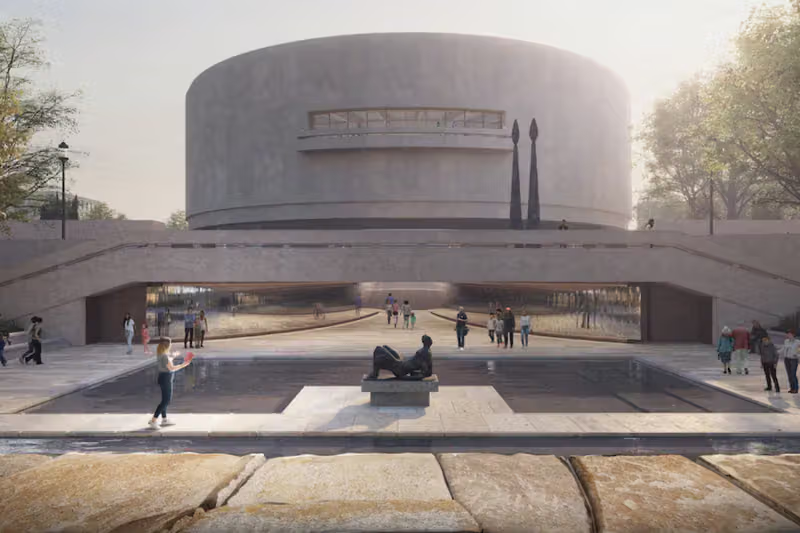
A passage sealed shut for nearly fifty years — older than most visitors who'll walk through it. The Hirshhorn Museum and Sculpture Garden, which opened on the National Mall in Washington, D.C. in 1974, originally had an underground passage connecting the museum building to its outdoor sculpture garden. That passage was later closed off, splitting people from the art across two separate spaces for half a century.

The person tasked with stitching it back together this time is Hiroshi Sugimoto. The Japanese artist and architect, who previously redesigned the Hirshhorn's lobby, has now taken on a far larger project: a four-year, $68 million overhaul aimed at the most thorough renovation of the campus since the museum opened in 1974. Rather than overturning architect Gordon Bunshaft's original modernist design, Sugimoto worked within its existing framework to reopen that underground passage — linking the museum building, the central plaza, and the sculpture garden into a single continuous flow for the first time.

Reopening on October 31, the 1.3-acre sculpture garden now has room for up to 60 works, roughly doubling both its space and its capacity for art. The curatorial logic is straightforward: on one side sits the collection left by founding donor Joseph Hirshhorn — unavoidable names in the history of modern sculpture like Auguste Rodin, Alberto Giacometti, Barbara Hepworth, and Henry Moore. On the other side sit new contemporary works by KAWS, Izumi Kato, Lauren Halsey, and Raven Halfmoon. Placing old and new on the same lawn isn't about one replacing the other — it's a deliberate staging of two eras of sculptural language, facing off across time.
The most notable "piece" in the garden isn't actually a sculpture — it's the oversized reflecting pool at its center. Designed so it can be fully drained, the pool transforms into an open-air performance space. Where it normally mirrors the sky, once emptied it becomes a stage instead. This kind of switchable-use space echoes, in a way, Sugimoto's longstanding fascination with time and the states of matter — whether water is present or absent completely changes the nature of the site.

The first exhibition after reopening is "Yoshitomo Nara: Sentinels of Stillness," which will run alongside the garden's permanent sculpture collection — a fitting opening statement for the reimagined space: let the site speak for itself first, then let a contemporary artist pick up the conversation.

Currently released information covers the scope of the renovation, the reopening date, and the roster of works on view; details on ticketing and guided tours have not yet been announced.

Related

Freddie Mercury's Yamaha C3 Piano Heading to Auction, Estimated at $528,000
Art

Freddie Mercury's Yamaha C3 Piano Heading to Auction, Estimated at $528,000

The Yamaha grand piano that recorded "The Game" and "Hot Space" at Munich's Musicland Studios will go under the hammer at Propstore, alongside Mercury's studio microphone and handwritten manuscripts.

Kenny Schachter on the Art World's Mess: Stop Complaining, Go Make Something
Art

Kenny Schachter on the Art World's Mess: Stop Complaining, Go Make Something

In a Hypebeast "State of Art" interview, artist, critic, and curator Kenny Schachter uses his three-decade obsession with Paul Thek to make the case for his own signature advice: instead of griping about the art world, just get to work.

Justin Bieber Puts Out Call on X: Wants to Make a SKYLRK Phone
Art

Justin Bieber Puts Out Call on X: Wants to Make a SKYLRK Phone

Justin Bieber took to social media to publicly announce he wants to build a SKYLRK phone, leaving behind a dedicated email address to recruit potential collaborators. The idea surfaced the same week SKYLRK has been rolling out a flurry of footwear and audio products.

Ben Quilty's NYC Debut "Devil/God": Turning Cars Into Phallic Idols, Stitching the Virgin Mary Into Corporal Punishment Leather
Art

Ben Quilty's NYC Debut "Devil/God": Turning Cars Into Phallic Idols, Stitching the Virgin Mary Into Corporal Punishment Leather

Australian painter Ben Quilty will present his solo exhibition "Devil/God" at albertz benda in New York, using thickly layered oil paintings and sculpture to confront masculine idolatry, religious power, and ecological collapse. The show opens October 15, 2026.

Yohei Ogawa Enters Trading Cards for the First Time, "Green Cow Garden" Pop-Up Lands at Hong Kong's BELOWGROUND
Art

Yohei Ogawa Enters Trading Cards for the First Time, "Green Cow Garden" Pop-Up Lands at Hong Kong's BELOWGROUND

Japanese illustrator Yohei Ogawa launches a debut trading card project with 137 designs at Hong Kong's BELOWGROUND, anchored by a 1.4-meter BG Bear statue on site. He also opened up about his own struggles trying to score Pokémon card packs.

Met Museum Displays Oldest Surviving Fragment of the Odyssey, Papyrus Reveals Three Lost Lines
Art

Met Museum Displays Oldest Surviving Fragment of the Odyssey, Papyrus Reveals Three Lost Lines

The Metropolitan Museum of Art has put the oldest surviving Ptolemaic-era papyrus fragment of the Odyssey back on display in Gallery 162. Dating to roughly 285–250 BCE Egypt, the ancient artifact contains three lines of verse not found in today's standard text.