ÉTAT HER

Paola Pivi: When Everything Gets Recorded, Where Does Play Go?

From a secondhand vacuum cleaner in a Milan warehouse to a wooden clog thrown across a childhood apartment complex, Paola Pivi's essay for designboom asks a pointed question: in an age of total surveillance, how much freedom is left in play?

Paola Pivi: When Everything Gets Recorded, Where Does Play Go?

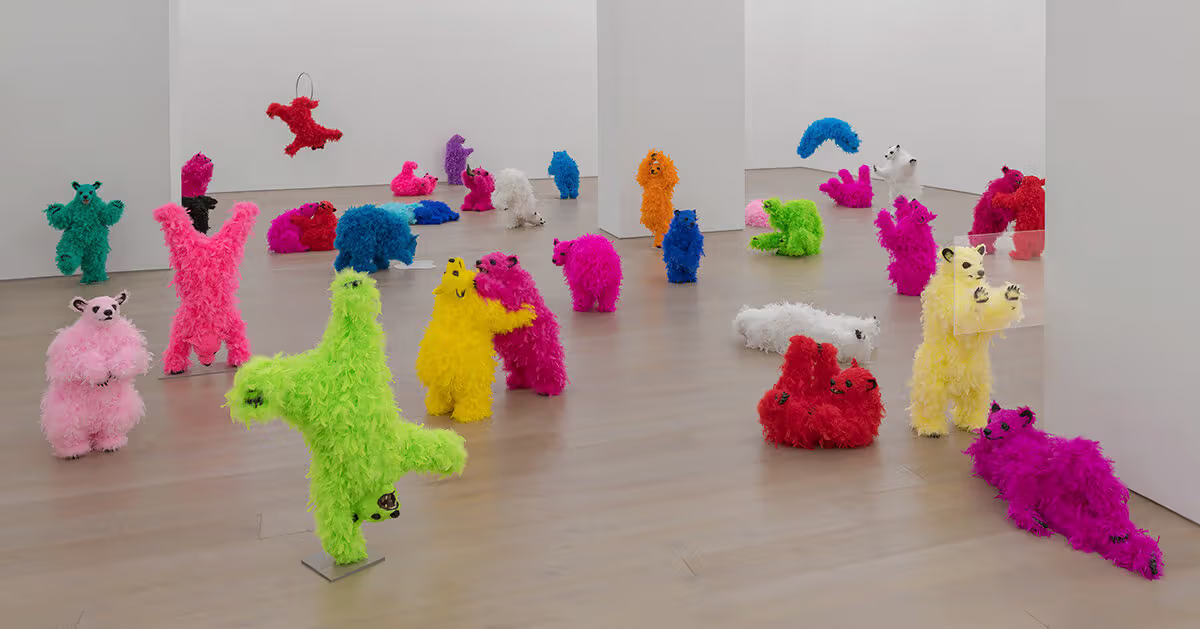
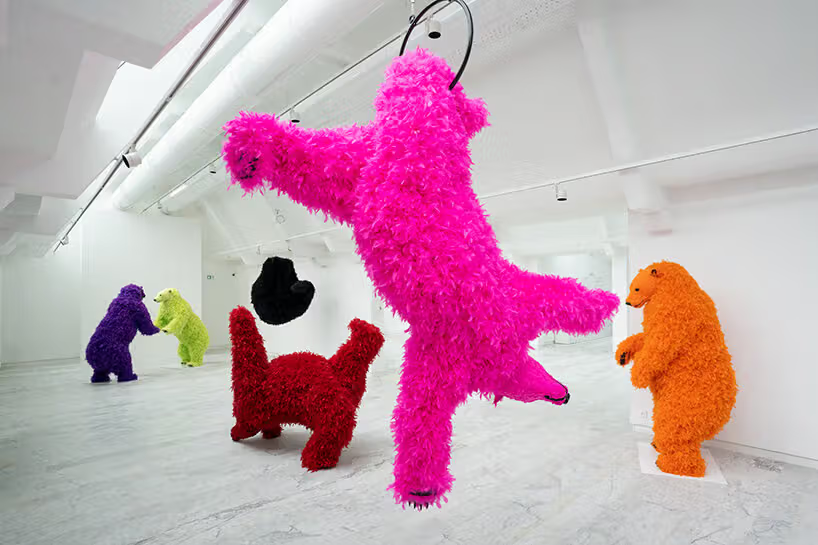
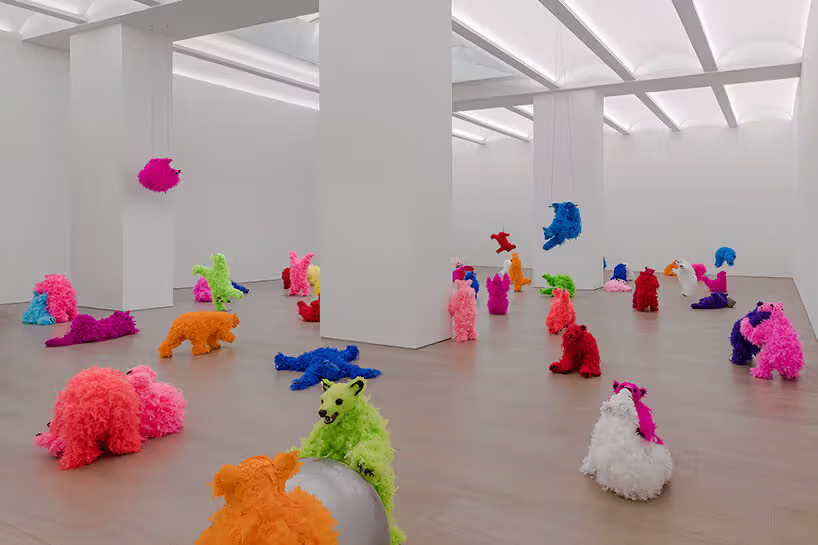
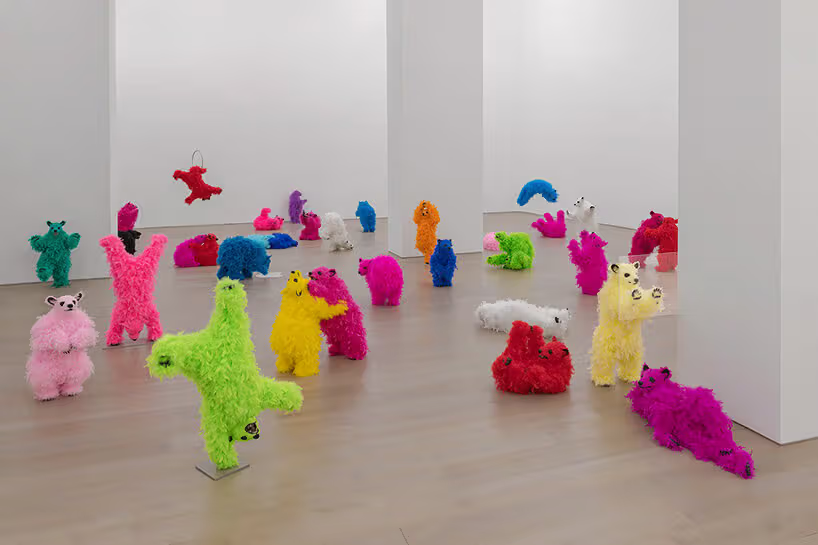
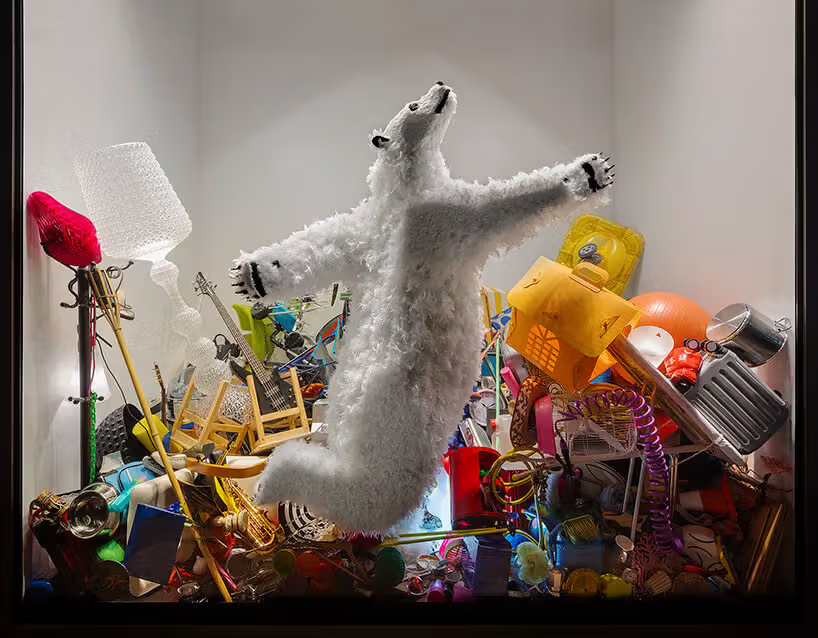
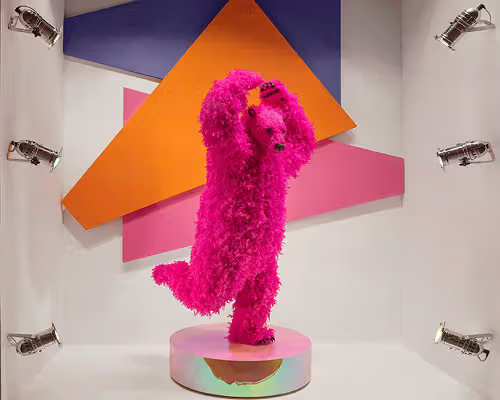
In a warehouse in Milan, wooden crates are stacked taller than a person, coated in dust that hasn't been disturbed in years. Paola Pivi and her longtime collaborator Matthew McPhillips climbed the crates bare-handed searching for something, their palms turning black, their clothes soaked through with sweat. Inside the boxes were props from her 2017 exhibition "Bad idea" at LaRinascente in Milan: a doghouse, a stroller, a tandem bicycle, a round trampoline, shovels, torches, a guitar—objects that had once been piled into a mountain, pinning a feather-covered polar bear inside a glass vitrine for her solo show "I am tired of eating fish." McPhillips remarked that day, "I wish people could see this side of the art world." Pivi considered bringing the trampoline home but decided to leave it where it was, as a stress-relief tool instead. Meanwhile, below them, her husband, composer Karma Culture Brothers, was absorbed in cleaning—he'd found four vacuum cleaners left over from various feather installations and was using one of them to clean the other three, completely lost in the task.
Paola Pivi: When Everything Gets Recorded, Where Does Play Go?

This scene appears in an essay Paola Pivi wrote for designboom's "PLAY" feature, published on August 10, 2026. What she wants to talk about isn't childlike wonder, but something sharper: the idea that this era has simply run out of room to play. She writes that every word we type, every sentence we speak, could be recorded and later used as evidence against us; even political beliefs feel unsettling now, since they might be pulled up and weaponized at a border crossing at any moment. Play once meant "trying something to see what happens, what you feel, what you think of"—an intellectual exploration built on freedom. She believes adults today no longer envy the free play of children not because that freedom doesn't matter, but because it has become so rare it's numbing.
Paola Pivi: When Everything Gets Recorded, Where Does Play Go?

The White Apartment Complex in Gallarate
Paola Pivi: When Everything Gets Recorded, Where Does Play Go?

Her childhood offers a counterpoint. Pivi grew up in the Ronchi area of Gallarate, Italy, in a large white apartment complex with deliberate architectural design and massing, set alongside a big lawn covered in white flowers and clover, where finding a four-leaf clover was a daily afternoon ritual. As the oldest among the "middle" group of kids by age, she was in charge of inventing and organizing games: all summer long, a pack of kids would play from morning until deep into the night, sometimes not heading home for dinner until close to midnight. They once squeezed themselves all into a small elevator, packed together like sardines, just to see what that felt like; they also played "cops and robbers," with a band of "robbers" sprinting between buildings, fleeing the one and only doorman. That doorman, from southern Italy, had a short temper and once hurled a wooden clog at them out of frustration—the kids knew he wasn't really aiming at anyone, but that uncertainty was exactly what sent their adrenaline through the roof.
They also explored the corridors of the underground storage rooms, crouched hidden on the trash-chute balconies of the top floor, or hid behind the round reception desk in the lobby, waiting to watch visitors walk straight into the fully glass entrance wall the architect had specifically designed. Someone would hang from a balcony railing just a few feet off the ground, swinging their legs, while others threw balls at full speed at a row of bodies like bowling pins. On the lawn stood a round concrete structure about twenty to thirty meters in diameter, originally built to enclose machinery, its walls curving slowly upward into a small tower they called "Torretta"—the little tower. The kids would walk along that curved wall like it was a tightrope.

Paola Pivi: When Everything Gets Recorded, Where Does Play Go?

From an Upside-Down Fighter Jet to a Spinning Plane in Central Park

Paola Pivi: When Everything Gets Recorded, Where Does Play Go?

Pivi carried that same impulse of "let's see what happens" straight into her creative process. In 1999, along with four other artists, she won the Golden Lion for Best National Participation at the Venice Biennale with "Untitled (airplane)"—a fighter jet flipped completely upside down—and afterward she found herself wondering "what else could be done with vehicles," landing on the answer: a plane that spins. In 2012, with support from the Public Art Fund, fabrication by Art Crating, and co-financing from Adam Lindemann, she mounted a Piper Seneca on a steel frame and motor, rotating it slowly at one revolution per minute at the entrance to Central Park's Doris C. Freedman Plaza. The installation measured 11.8 x 12.9 x 11.8 meters and was titled "How I Roll." She admits it's hard for her to say it outright, but the whole process from concept to realization was, at its core, essentially no different from play.

Back in that warehouse full of old props, the scene she describes already gives the answer: play hasn't really disappeared, it's just retreated into corners that go unrecorded—a warehouse, a vacuum cleaner, two adults with dust-covered hands, still laughing. This essay was written for designboom's PLAY series; the original source did not include details such as pricing or exhibition dates.

Related

Frank Kunert Pulled the Tiny People Out of His Models — And That's When the Architecture Started Lying
Art

Frank Kunert Pulled the Tiny People Out of His Models — And That's When the Architecture Started Lying

German photographer Frank Kunert hand-builds his scenes at scales from 1:12 to 1:43, but early on he made a call to strip out the figurines — letting a staircase, or an apartment wedged under an overpass, tell the story on its own.

Freddie Mercury's Yamaha C3 Piano Heading to Auction, Estimated at $528,000
Art

Freddie Mercury's Yamaha C3 Piano Heading to Auction, Estimated at $528,000

The Yamaha grand piano that recorded "The Game" and "Hot Space" at Munich's Musicland Studios will go under the hammer at Propstore, alongside Mercury's studio microphone and handwritten manuscripts.

Kenny Schachter on the Art World's Mess: Stop Complaining, Go Make Something
Art

Kenny Schachter on the Art World's Mess: Stop Complaining, Go Make Something

In a Hypebeast "State of Art" interview, artist, critic, and curator Kenny Schachter uses his three-decade obsession with Paul Thek to make the case for his own signature advice: instead of griping about the art world, just get to work.

Justin Bieber Puts Out Call on X: Wants to Make a SKYLRK Phone
Art

Justin Bieber Puts Out Call on X: Wants to Make a SKYLRK Phone

Justin Bieber took to social media to publicly announce he wants to build a SKYLRK phone, leaving behind a dedicated email address to recruit potential collaborators. The idea surfaced the same week SKYLRK has been rolling out a flurry of footwear and audio products.

Ben Quilty's NYC Debut "Devil/God": Turning Cars Into Phallic Idols, Stitching the Virgin Mary Into Corporal Punishment Leather
Art

Ben Quilty's NYC Debut "Devil/God": Turning Cars Into Phallic Idols, Stitching the Virgin Mary Into Corporal Punishment Leather

Australian painter Ben Quilty will present his solo exhibition "Devil/God" at albertz benda in New York, using thickly layered oil paintings and sculpture to confront masculine idolatry, religious power, and ecological collapse. The show opens October 15, 2026.

Yohei Ogawa Enters Trading Cards for the First Time, "Green Cow Garden" Pop-Up Lands at Hong Kong's BELOWGROUND
Art

Yohei Ogawa Enters Trading Cards for the First Time, "Green Cow Garden" Pop-Up Lands at Hong Kong's BELOWGROUND

Japanese illustrator Yohei Ogawa launches a debut trading card project with 137 designs at Hong Kong's BELOWGROUND, anchored by a 1.4-meter BG Bear statue on site. He also opened up about his own struggles trying to score Pokémon card packs.