ÉTAT HER

Utah's SB 73, the First US Law Forcing Websites to Answer for VPN Use, Gets Suspended Right as It Was Due to Start

Though set to kick in this Thursday as the nation's first law holding websites accountable for VPN usage, Utah's SB 73 won't be enforced for now—the state's Department of Commerce is waiting on a federal judge's ruling in Aylo's lawsuit.

Tzu-Han Chou, Travel Editor
Utah's SB 73, the First US Law Forcing Websites to Answer for VPN Use, Gets Suspended Right as It Was Due to Start

A law that gets shelved by the very agency meant to enforce it, on the day it takes effect — that's where Utah's SB 73 stands right now. The bill was originally set to officially go into effect this Thursday, but the Utah Department of Commerce has already signaled it won't be implementing the regulation until a federal judge rules on the related lawsuit. Fox 13 News reported on the department's decision.

SB 73 is the first state law in the US to directly write VPN usage into an age verification framework. It was signed into law by the Utah state legislature back in March, with an original effective date of May. Under the bill, anyone physically located within Utah is considered to be "accessing the website from Utah," regardless of whether they're connecting through a VPN. The law also requires that any website with "a substantial portion of content harmful to minors" cannot assist or encourage users in using VPNs.

The law doesn't directly ban VPNs — instead, it puts websites on the hook for their users' VPN activity, and that's exactly what privacy and digital rights groups are most worried about. The Electronic Frontier Foundation issued a warning about the law back in April: "If a website can't accurately determine the true location of a VPN user, yet the law requires it to do so for all users in a given state, the legal risk could push websites to either block all known VPN IPs or require age verification from every visitor worldwide." The organization noted that this could mean millions of users, regardless of their actual location, being forced into invasive identity checks or outright blocked.

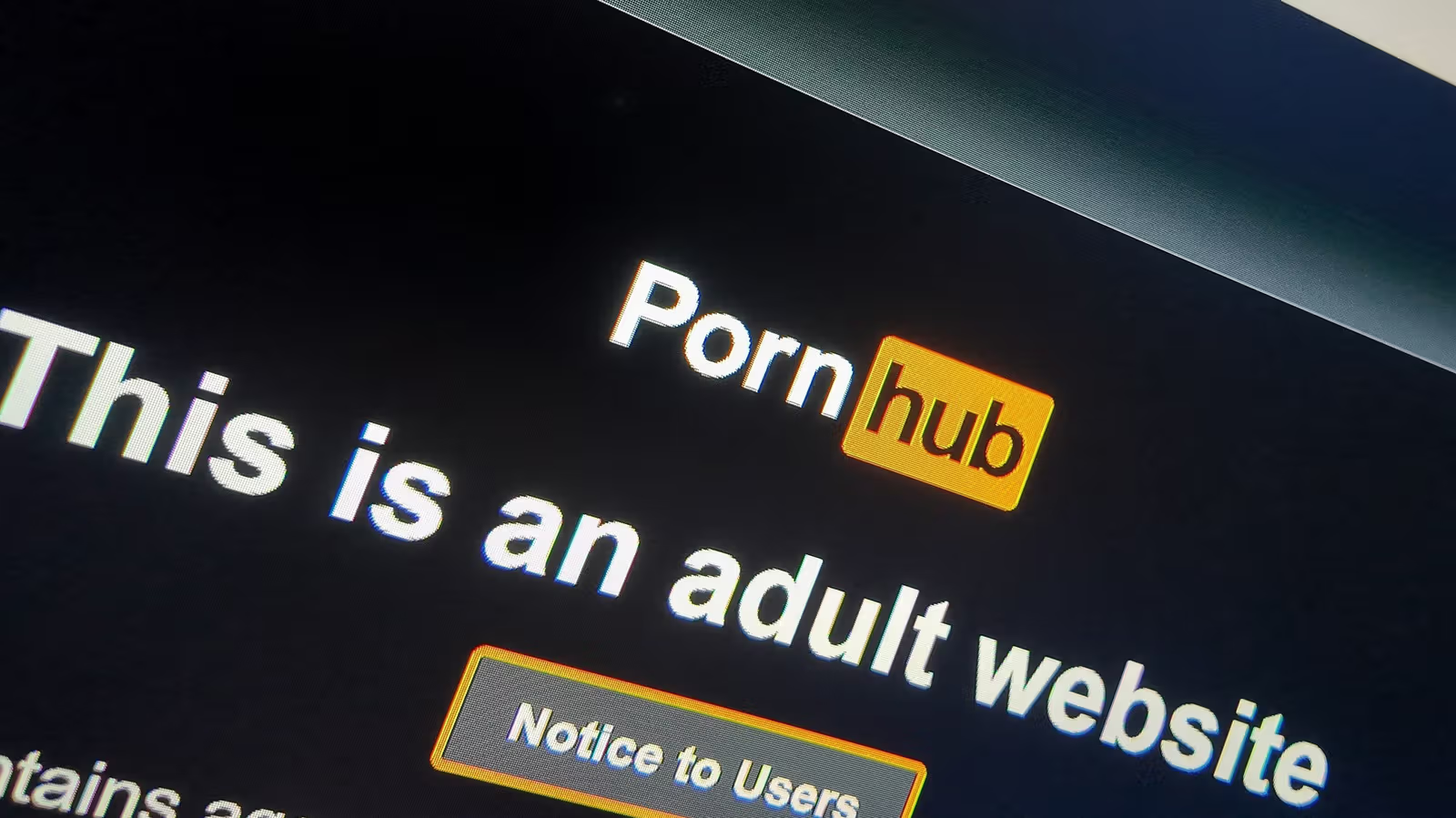
SB 73's road to implementation hasn't been smooth. The law was originally supposed to take effect in May but was delayed after Pornhub's parent company Aylo filed a lawsuit in federal court. Now Utah has once again agreed to postpone enforcement until the lawsuit is resolved. At Thursday's hearing, the presiding judge said he "couldn't promise when a ruling would come," according to Fox 13 News. That means this tug-of-war still has no clear timeline in sight.

Aylo and Pornhub have long been among the most vocal opponents of age verification laws in Utah and other states. The company says it's not against age verification in principle, but argues that the way US states are currently implementing it exposes users to "significant risks, including identity theft." In response to these regulations, Pornhub has chosen to block access outright in 25 states across the US rather than comply with verification requirements.
Related

What to know | Rugged Phone Hides an Action Cam: RugOne Xsnap 7 Pro's Camera Module Detaches with Magnets
Living

What to know | Rugged Phone Hides an Action Cam: RugOne Xsnap 7 Pro's Camera Module Detaches with Magnets

The key details: Ulefone's sub-brand RugOne unveiled the rugged Xsnap 7 Pro at IFA 2026, featuring a camera module on the back that can be fully detached and carried around as a waterproof action cam. Early-bird pre-orders open on Kickstarter September 7 at €799.

No Steering Wheel, No Problem: Tesla's Cybercab Now Officially Serving Riders in Austin
Living

No Steering Wheel, No Problem: Tesla's Cybercab Now Officially Serving Riders in Austin

Austin riders can now hail a ride via Tesla's Robotaxi app, though specifying a vehicle type isn't yet an option—among the 314-vehicle fleet, dominated by Model Ys, 45 are Cybercabs.

What to know | Boox Go 6 Gen II Review: The E-Reader That Runs Google Play, but the Battery Only Lasts Eight Days
Living

What to know | Boox Go 6 Gen II Review: The E-Reader That Runs Google Play, but the Battery Only Lasts Eight Days

The key details: The $200 Boox Go 6 (Gen II) runs Android, letting you install any reading app and use a stylus, but its battery life falls well short of Kindle and Kobo—and it's still stuck on Android 11, which has already lost security updates.

Anthropic Gives Users the Power to Rewrite What Claude Remembers Long-Term
Living

Anthropic Gives Users the Power to Rewrite What Claude Remembers Long-Term

With new granular controls rolled out by Anthropic, Claude users can now edit or delete memories by topic and decide whether sensitive information gets included at all.

Samsung Devices Set to Gain Android's Scam Detection, With the Galaxy S26 Leading the Rollout
Living

Samsung Devices Set to Gain Android's Scam Detection, With the Galaxy S26 Leading the Rollout

Previously exclusive to Pixel phones, Google's AI-powered call scam detection is now confirmed to be coming to the Samsung Galaxy S26. Android's security toolkit also includes several often-overlooked features, such as updates, two-factor authentication, Find Hub, and anti-theft locks.

Can a Gimbal Fit in 9.6mm? Honor Robot Phone Pushes Physical Limits
Living

Can a Gimbal Fit in 9.6mm? Honor Robot Phone Pushes Physical Limits

To give the 200MP main camera three-axis stabilization, Honor developed its own 2.6-gram gimbal motor and hid it inside the phone's back cover. Available only in China as a limited run, this experimental device delivers a hands-on experience that sits between a standard phone and a dedicated gimbal camera.