What to know | A Business Pitch or a Date: Finding the Right Moment with GATSEE
The key details: Pitching an idea, planning a date or starting a new project? GATSEE brings daily auspicious hours, event planning and a personal calendar together. This guide explains the time slots, their reasoning, and the free, membership and credit-based features.
The presentation is on its eighth revision, cursor hovering over "send"; the date spot is already picked, but those words you've been meaning to say are still rehearsing in your head. Life is full of these moments: the content is basically ready, but you still want to pick the perfect time to begin.
That's exactly the feeling GATSEE taps into. It brings together daily hour cycles, your personal birth chart, and whatever you're planning to do: Which time slot today is good for speaking up? Which day next week works best for discussing a partnership? Can two people's lucky hours actually line up? From opening the app each day to scheduling something specific, the platform tries to turn the fortune-telling concept of "timing" into something you can read, search, and compare in everyday life.
This article walks you through the actual features: first picking something you want to do, then checking the rhythm of a single day, and finally extending into the personal calendar, personality readings, and relationships. If you're into fortune-telling, you can dig into the logic behind it; if you're new to this, there's a clear starting point too.
Put what you want to do into a timeline, and give yourself a little extra courage to begin.
First, pick what you're doing: a business discussion, an interview, or a date?
The most relatable entry point is "Event Planning". It starts by asking what you're planning: business talks, signing contracts, interviews, client meetings, dates, moving, traveling, starting a new project—even studying for exams or wrapping things up. There's an option for all of it.
Once you pick an event, you can view options for the next 3, 7, or 14 days. The screen puts recommended time slots up front, listing the date, time range, hour, direction, and the reasoning behind each pick; other candidates are listed below so you can match schedules with the other party. Time slots mostly run from 5 a.m. to 9 p.m., keeping recommendations closer to everyday routines.
Pick what you're doing, then compare candidate times over the next few days. The recommendation card keeps both the supporting reasons and the things to watch out for, with an "Add to Calendar" option built right in.
For example, say you're planning to meet a client next week to discuss a partnership. Here's how to do it step by step:
Pick the event:Tap "Business Discussion," then decide how many days ahead to check.
Check the candidates:From the recommendation card and other time slots, pick a date and time that actually works for your schedule.
Read the reasoning:Expand "How this slot was chosen" to see which perspectives support it, and which conditions suggest you proceed carefully.
Sync back to your schedule:Confirm the time zone and your own plans before using the calendar feature. The actual content of the discussion, the other person's schedule, and any prep work still need to be factored in.
The recommendations draw on multiple perspectives: auspicious hours, planetary hours, traditional almanac timing, Qimen Dunjia, Nine Star Ki directions, and personal birth charts. The "number of methods in agreement" shown on screen indicates how many sources support a given time, while also flagging reminders about direction or starting times—helping readers understand why things are ranked the way they are.
How should you spend today? Check the overall climate first, then your personal fortune, then pick your moment
If you just want to get a handle on today, start from the "Today" page. It breaks information into three layers, meant to be read in order:
Overall Climate:Where today falls in the lunar calendar and solar terms, almanac dos-and-don'ts, and other background shared by everyone that day.
Personal Fortune:How the day maps onto your personal birth chart, with insights across general outlook, work, relationships, money, and health/rest.
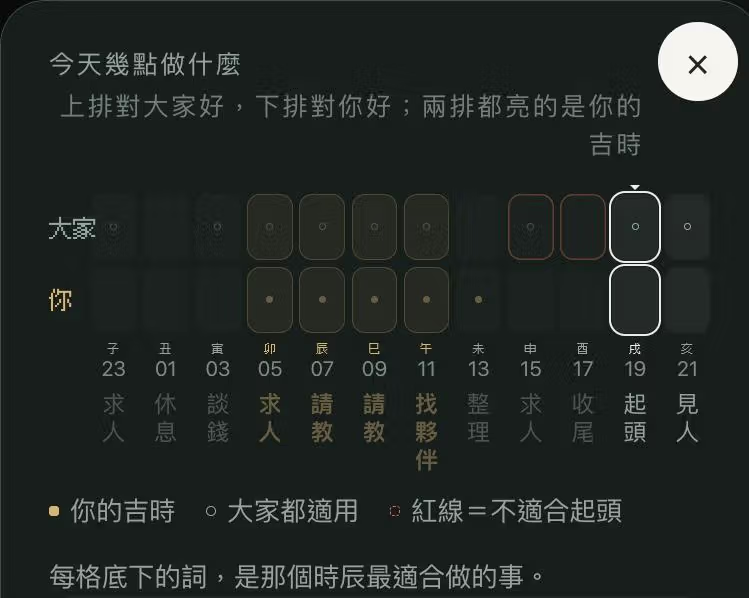
Timing:Breaks the day down into twelve traditional hour blocks, showing which ones line up with your personal conditions, along with what's good to do and what to watch out for.
The twelve-hour table is shown in two rows: the top row shows shared conditions, the bottom row shows personal conditions. Each hour block is labeled with its clock time—for example, the Mao hour runs 05:00–07:00—so you don't need to memorize the traditional terms. Gold markers, open circles, and warning lines keep information from different sources visually distinct.
The dual-row timeline separates "shared across everyone that day" from "specific to you." Check the clock times first, then read both rows of markers along with the notes below—that's how you figure out which time slot the page is recommending.
When reading this table, it's worth paying extra attention to whether both rows light up at the same time. A slot favored by the almanac might still carry a separate warning from your personal conditions; the screen lists both rather than only showing the good news. This is also why two different people opening the site on the same day might see different personal lucky hours.
The current-hour card condenses everything into something readable at a glance: the current or next time slot, start and end times, a countdown or remaining time, plus dos-and-don'ts and action tips. You can expand it to check the whole day, without having to read through an entire birth chart every time.
Lay out a whole month, and the good days find their place
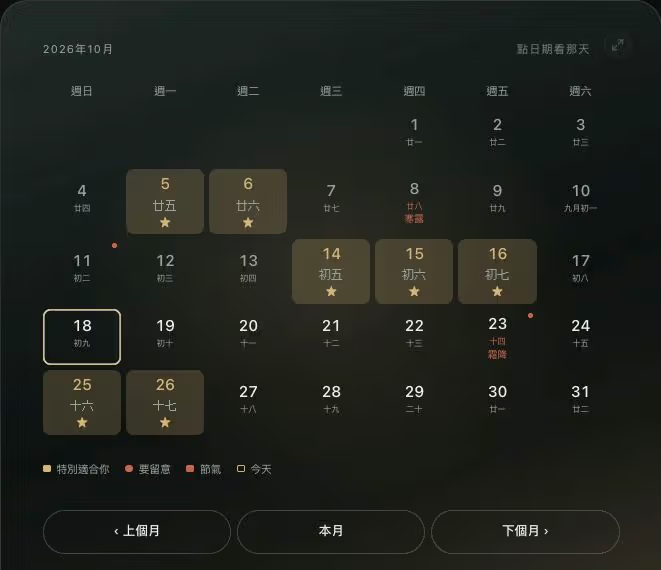
Planning an important meeting usually isn't just about "what time today"—it starts with "which day this month works best."Personal Almanac CalendarDates, lunar calendar, solar terms, and personal markers all appear on the same calendar, letting you start from the big picture of the whole month before zooming into a specific day.
The calendar extends "viewing a day" into "viewing a month." The gold-marked dates shown reflect the personal results for the account in this screenshot; switching months or dates keeps the corresponding info updated.
This entry point works well for a first pass: cross off the days you're already swamped, then compare what's left among the open dates. Once you've settled on a date, head back to the hourly view or event planning to line it up with an actual meeting, outing, or kickoff time.
The platform also stretches time into a longer scale. "Today" includes cyclical info spanning major luck periods, years, months, days, and hours, plus entry points for monthly fortune, yearly timelines, and annual reports. For those willing to track things slowly, these can serve as prompts for reviewing recent life: What's actually been taking up your time lately? Which one thing deserves a bit more attention?
Twenty-four systems, each needing what kind of data?
Another core thread of GATSEE is self-discovery. The official site currently lists twenty-four fortune-telling and personality systems, but they each require different inputs. Even after setting up a birth profile, tools based on name, questionnaires, specific questions, and numbers each have their own way of taking input.
Data Required
Corresponding Systems
How to Start
Birth Data, 12 Systems
BaZi, Zi Wei Dou Shu, Korean Saju, Five Elements, Chinese Zodiac, Nine Star Ki, Western Astrology, Vedic Astrology, Human Design, Numerology, Mayan Calendar, Cartomancy
Set up a profile with birth date, time, and location; charts are generated based on what each system requires.
Name, 2 Systems
Name Analysis, Chaldean Numerology
Provide a Chinese character name or alphabetic name depending on the system.
Questionnaire, 1 System
Enneagram
Answer the questionnaire; your choices reveal personality tendencies.
One Question, 6 Systems
I Ching, Plum Blossom Numerology, Qi Men Dun Jia, Tarot, Oracle Cards, Sixty Jiazi Fortune Sticks
Bring whatever question is on your mind right now into the corresponding tool.
A Number or Name, 3 Systems
Phone number, license plate, brand name
Enter the number or name you want to explore and read its playful interpretation.
The personal profile organizes readings from related systems into twenty-six personality dimensions, covering self, emotions, love, social life, career, wealth, creativity, decision-making, and growth. Readers can see which systems point in similar directions, and can also trace the reasoning back through the WHY or underlying logic to find the basis for each reading.
Wanting to climb higher and also wanting to do things well: sometimes the contradictions are more interesting than the labels
A personality description where every line sounds like a compliment is easy to read and forget. GATSEE also has a "Your Contradictions" card that puts different systems' opinions side by side, letting readers see where the tension actually comes from.
The contradiction card places two interpretations alongside their respective sources. Readers can start by asking "which side feels more like me right now," then go back to the original system for details.
Take this browsing screenshot as an example: for the same career dimension, some systems lean toward pushing upward and striving, while others lean toward getting the work right where you are. Mapped onto real life, this can become a very concrete question: is wanting to take on a new project right now about wanting to grow, or about the current work not yet feeling done to your satisfaction? The agreement and disagreement between systems offer a way of reading, not a measure of predictive accuracy.
Birth charts, Human Design, Tarot, and compatibility readings — where to go next?
For those who want to go deeper, individual systems are available. Western astrology offers zodiac signs, houses, planets, and aspect charts; Human Design pairs visuals like energy centers and channels with explanations of personality and decision-making style; Tarot lets you start from your life card, year card, or whatever question is on your mind right now. Each entry point focuses on a different question, so readers can start with whichever one interests them most.
Relationships get their own entry point too. Compatibility readings can be read from angles like romance, marriage, friendship, family, teams, business partners, or travel companions for people you've already saved; the page also checks the coming days for times when both people's conditions align. Planning a conversation, collaboration, or meetup together gains an extra layer of timing to compare.
To hold onto today's content, the share card also offers themes like lucky hours, fortune, card draws, or lucky colors, and can be paired with your own caption. Jotting down how you feel and looking back a few days later can sometimes reveal your own rhythm better than rushing to find a conclusion in the moment.
Which part does AI handle? What about unfamiliar fortune-telling terms?
According to the official explanation, charts are calculated by each system's dedicated engine, and AI then writes the personalized analysis based on the completed signals and reasoning. The official statement is that birth date, time, and similar data are not provided to the text-generating AI; this is how the brand publicly describes its data handling.
The platform also offers terminology explanations, unfolding layer by layer from meaning to real-life implications to common misreadings. When you run into unfamiliar terms like "Seven Killings" or "Palace of Illness," you can click to see the explanation first, then decide whether to go deeper. This reading order gives beginners a chance to understand a term first, instead of being intimidated by the name itself.
Free, Membership, and Credits — sort it out before you start
According to the current official pricing page, new accounts get seven days of full member access to try out. After the trial ends, here are the main differences between free and paid; actual benefits and pricing are subject to the page at time of use.
How to Use
Main Scope
Free
Twenty-four systems of chart calculation, two full readings of your choice each day, the next twelve hours' shared auspicious times, this month's almanac, basic six-section profile, consensus & WHY, basic glossary explanations; one question per day, with one saved compatibility profile.
Premium Membership
Personal auspicious times and reminders, more complete fortune explanations, a personal calendar with monthly breakdowns, in-depth readings across all systems, the full twenty-two-section profile, personal AI analysis, and more compatibility profiles; each cycle comes with 10 points.
Readings That Require Points
According to the official site, a single tarot reading costs 1 point, a triple reading costs 2 points, an advanced compatibility AI report costs 2 points, and special reports cost 3 points. Membership benefits and individual point-deducting items should be considered separately — points currently have no expiration date.
The thing most easily confused is shared auspicious times versus personal auspicious times: the free tier lets you get familiar with the day's shared information first, while personalized auspicious times and reminders are listed under membership benefits. Plans purchased via NewebPay are currently described on the official site as prepaid periods, with no automatic renewal charges once they expire.
The First Time You Open It, Do These Three Things First
First, set up your profile:Log in with Google or Apple and fill in your own birth information. If you don't know your birth time, use the unknown or approximate time option provided in the interface; for parts that require a complete time to work, follow the available range indicated on the page.
Then, look at today:Following the order of trend, fortune, and timing, pick the one time period you want to understand and expand on the reasons and reminders.
Finally, schedule one thing:Go into schedule planning, pick one thing you actually need to do soon, and compare the candidate time slots with your existing schedule. Once you've got a handle on this one entry point, slowly explore the other systems — your reading will be much more focused.
Where auspicious times are easiest to bring into daily life is by making "when" more specific. Preparing a proposal? Check the candidate times for discussing cooperation. Planning to meet someone? Compare both people's schedules. Been feeling chaotic lately? Open up the calendar and sort out your own rhythm. Time gives you a starting point — the conversations, preparation, and action that follow are still up to you.
GATSEE positions its service as entertainment, self-reflection, and cultural interpretation; auspicious times and astrological readings do not guarantee outcomes. The header image is an AI concept illustration; the in-article images are actual interface screenshots taken on October 18, 2026, framed to exclude names, contact details and birth information. Personal results, plans, and interfaces shown may vary by account, date, or version.