Brad Smith: Milk Cartons Face Tougher Rules Than AI Right Now
Microsoft's president told ITV that AI oversight still trails basic consumer safeguards—even those for washing machines or milk—and suggested the US regulatory gap could let the UK step up as an early rule-setter for AI.
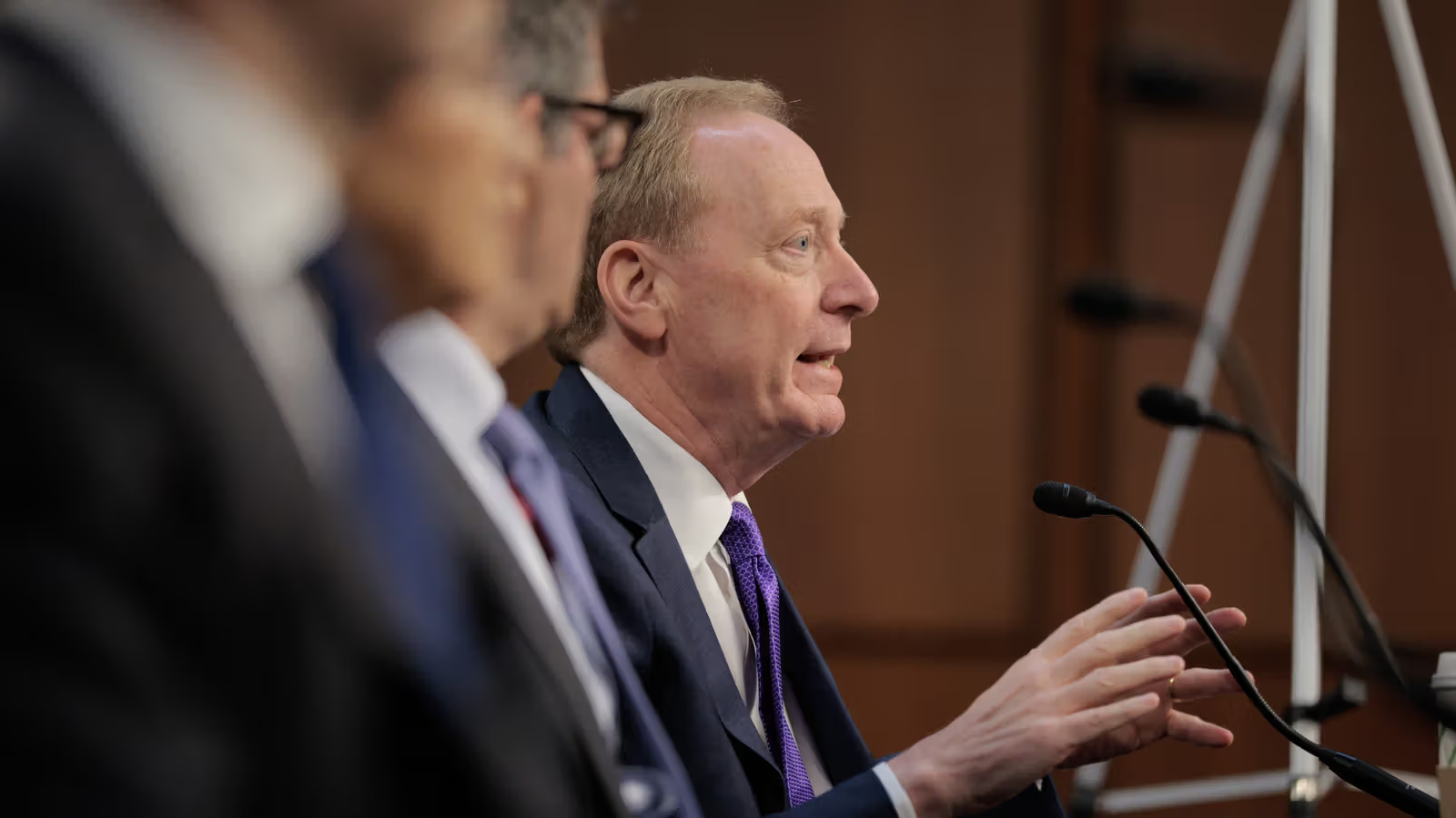
A carton of milk sitting in a supermarket fridge, stamped with a safety inspection label—this is the image Microsoft President Brad Smith used to illustrate just how far behind AI regulation has fallen. In an interview with ITV, he put it bluntly: "Right now, your washing machine at home is subject to more safety regulation than AI. Every carton of milk you see in the supermarket has to go through safety rules and inspections."
Behind that remark lies a tug-of-war within the US AI industry between full-speed-ahead acceleration and calls to slow things down. Companies like Anthropic, OpenAI, and Google's DeepMind have all voiced support for slowing AI development, but US President Trump holds the opposite view—he argues the American AI industry needs to move faster to stay ahead of China, and prefers regulation to be left largely to industry self-governance.
At what's been dubbed the "superintelligence" summit hosted by Trump, a group of AI industry leaders—including Google CEO Sundar Pichai, Anthropic CEO Dario Amodei, Meta founder Mark Zuckerberg, OpenAI President Greg Brockman, Tesla CEO Elon Musk, and Nvidia CEO Jensen Huang—jointly signed an agreement. The deal includes commitments for companies to establish their own safety standards, build in safeguards to prevent frontier models from going out of control, and bring in "independent auditors" to evaluate model performance.
The agreement hasn't been universally welcomed. According to a BBC report, one critic pointed out that this essentially lets companies "define what counts as safe" themselves; another said flatly that "this agreement should be treated as a distraction and simply ignored."
Smith, meanwhile, turned his attention across the Atlantic. He believes America's regulatory sluggishness actually gives the UK a unique opening. "In Washington, DC, people don't view the UK and London the way they view Brussels—and that's actually an advantage," he said. He added: "I hope this is a role Microsoft as a company can play, and I hope it's a role the UK as a nation can play. When you see models powerful enough to put the world's cybersecurity at risk, I'd say: the time has come."