ÉTAT HER

Better Specs, Worse Sales: The GameCube vs PS2 Mystery Explained

It had the stronger processor and superior tech—yet GameCube sold roughly 8 times less than PS2. We break down the Gekko chip, the mini-disc's storage limits, and the numbers that reveal why raw power didn't win this console war.

Hsin-Yi Ho, Food Editor
Better Specs, Worse Sales: The GameCube vs PS2 Mystery Explained

A console that dominated its rival on paper in every way, yet ended up selling only a seventh as many units—that's the puzzling gap GameCube and PlayStation 2 left behind for gamers to ponder. PS2 launched in North America in October 2000, with GameCube arriving over a year later in November 2001. Looking purely at hardware, GameCube had almost no reason to lose.

Sony's PS2 was powered by a 295MHz processor codenamed Emotion Engine, splitting computational tasks between the main CPU and two Vector Units handling geometry calculations and lighting effects separately. This division of labor gave many developers a hard time in the system's early days, and it wasn't until Criterion later licensed out its RenderWare engine that the development process became smoother.

The Advantages of the Gekko Processor and Flipper Graphics Chip

By comparison, GameCube's 485MHz Gekko processor ran at a noticeably higher clock speed, paired with the custom-built Flipper graphics chip that could process up to eight layers of polygon effects in a single rendering pass—whereas PS2 needed multi-pass rendering to achieve similar results. Flipper also had built-in S3 texture compression, saving CPU resources compared to software-based compression. On the memory front, GameCube's 40MB of MoSys RAM not only outclassed PS2's 32MB Rambus RAM in capacity, but also delivered lower latency.

Julian Eggebrecht, former president of Factor 5, gave a blunt assessment in an interview with IGN: "Based on our calculations, the GameCube's CPU performance is equivalent to the PS2's CPU plus its VU0 combined—if not more. Everything VU1 does on the PS2, GameCube's Flipper graphics chip handles in hardware." He added: "When it comes to texturing and hardware lighting, GameCube completely crushes the PS2—there's really no comparison."
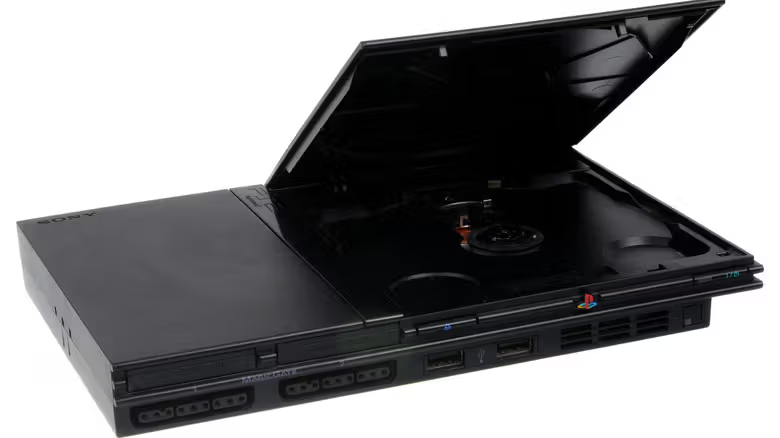

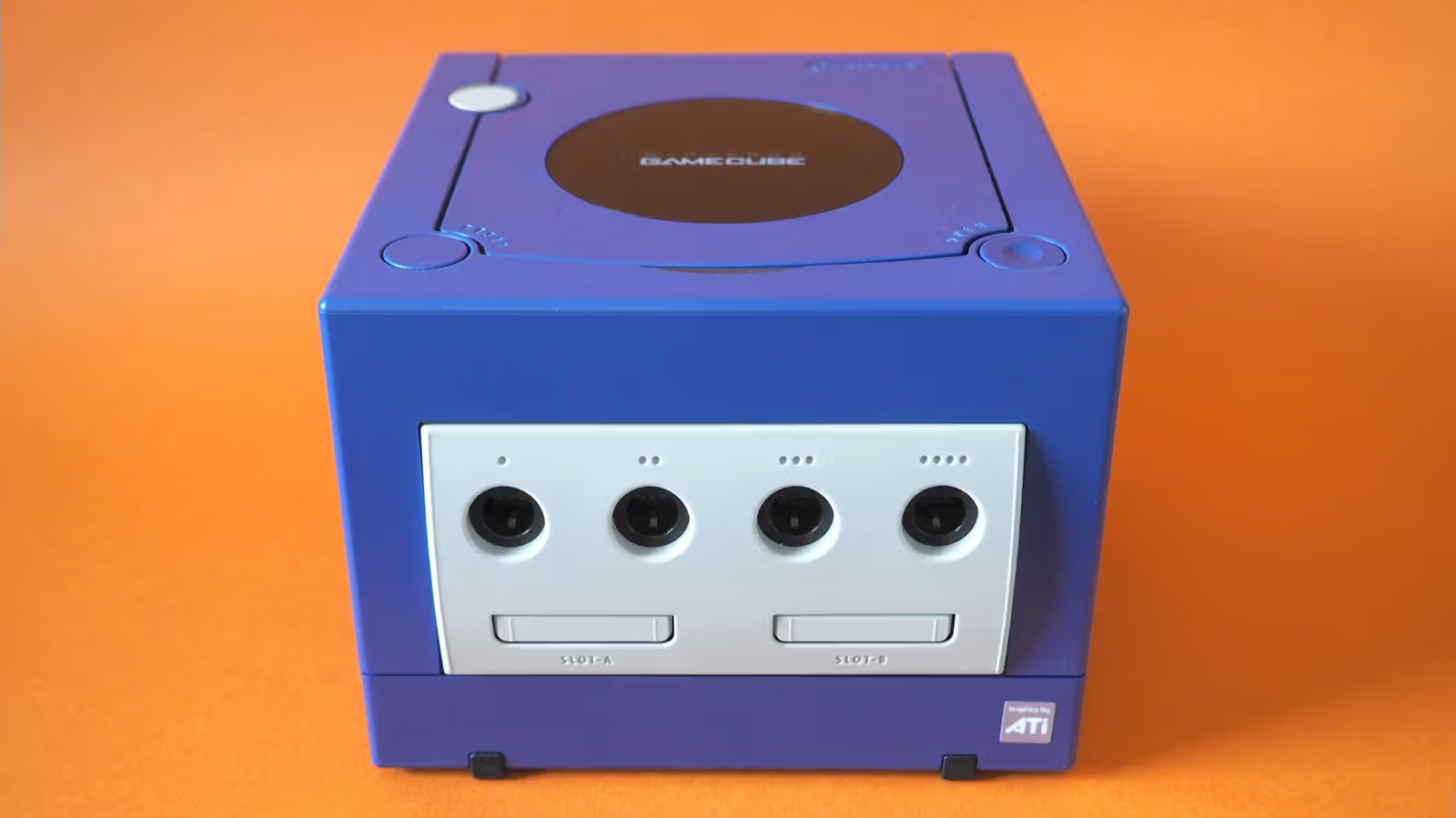
GameCube's Hardware Crushed PS2 on Paper—So Why Did It Sell Nearly 8x Less?

But GameCube had one fatal weakness—disc capacity. Its mini-discs held only 1.5GB, while standard DVDs of the era offered at least 4.7GB, a gap that directly limited how much third-party content could be ported over.

Won the Hardware Battle, Lost the Living Room

Looking at the sales numbers, PS2 is the best-selling home console of all time, moving 160 million units from launch through its 2013 discontinuation. GameCube, on the other hand, sold just 21.7 million units between 2001 and 2007 before being replaced by the Wii.

PS2's success came down to the audience it reached. GameCube was widely seen as skewing toward a younger demographic, while PS2 leaned into more mature marketing—including a controversial ad styling the console's controller as a condom—paired with a lineup of games aimed at older audiences, drawing in a much broader user base. PS2 also doubled as a DVD player, was priced competitively for the era, and had a more understated design than GameCube, making it an easier fit for living room entertainment setups.

In terms of library size, PS2 boasted nearly 4,500 games, with third-party support far outpacing GameCube—thanks partly to its earlier launch driving early sales momentum, and partly to GameCube's disc capacity limitations discouraging third-party developers. Series like Ratchet and Clank, Jak, Metal Gear Solid, and Persona stood as flagship titles in PS2's exclusive lineup. PS2 also offered backward compatibility, giving players access to an even larger game library, while GameCube—despite having several beloved exclusives of its own—mostly appealed to existing Nintendo fans and couldn't play games from its predecessor.

Related

SNK's Neo Geo AES+ Won't Arrive Until September 2027 — Blame the AI Memory Shortage
Living

SNK's Neo Geo AES+ Won't Arrive Until September 2027 — Blame the AI Memory Shortage

Plaion Replai's officially licensed Neo Geo AES+ reboot console, once slated for this November, now ships September 16, 2027. The delay stems from memory chip shortages triggered by AI infrastructure demand, though pricing stays the same.

iOS 27 Lets One Number Live on Two iPhones—T-Mobile Adds $5 Monthly Fee
Living

iOS 27 Lets One Number Live on Two iPhones—T-Mobile Adds $5 Monthly Fee

With iOS 27's iPhone Handoff, a single eSIM number can move between two iPhones. T-Mobile is the only US carrier launching support for it, and it's tacking on an extra $5 a month for the privilege.

Google Brings Gemini Straight to Your Windows Desktop
Living

Google Brings Gemini Straight to Your Windows Desktop

A dedicated Gemini app now runs natively on Windows 10 and 11, popping up with the same Alt + Space shortcut as its Mac counterpart. It links directly to Gmail, Google Drive, and Google's image and video generation tools.

Card-Free Playback Arrives on Yoto's Latest Kids' Players—Alongside Higher Price Tags
Living

Card-Free Playback Arrives on Yoto's Latest Kids' Players—Alongside Higher Price Tags

A new green button on both the 4th-gen Yoto Player and the upgraded Yoto Mini lets children start their favorite content without inserting a card at all, though the devices now cost $150 and $110 respectively, up from before.

Two Nintendo Directs, One Big Reveal: Switch 2 Ports Pile Up Before Metroid and Kirby Steal the Finale
Living

Two Nintendo Directs, One Big Reveal: Switch 2 Ports Pile Up Before Metroid and Kirby Steal the Finale

The week's second Nintendo Direct leaned heavily on Switch 2 ports—Monster Hunter Wilds, Final Fantasy 7 Revelation, and a Witcher 3 remaster all made the cut—saving Metroid Ravenous and Kirby and the World Beyond for a surprise closing reveal.

Lawsuit Targets Anthropic: Claude Max's "5x, 20x Usage" Claim Allegedly Masked a Murky Weekly Limit
Living

Lawsuit Targets Anthropic: Claude Max's "5x, 20x Usage" Claim Allegedly Masked a Murky Weekly Limit

Anthropic now faces a class action from Claude users who argue that the Max subscription's touted "5x and 20x usage" figures obscured undisclosed weekly caps, potentially leaving actual usage multipliers well below what was promised.