From Jerzy to Jorge: A Name Change, Two Homes of Modernism
Polish architect Jorge Zalszupin escaped the Holocaust and drifted through France before settling in Brazil, where he took a new name upon gaining citizenship and fused European rationalism with tropical woodgrain in his furniture designs—work now set to be exhibited in Milan in 2026.
In 1949, a man named Jerzy Zalszupin set foot on Brazilian soil, likely with no idea he'd one day change his name. A few years later, upon gaining Brazilian citizenship, he switched it to "Jorge"—a decision later seen as the turning point of his design career: a Polish architect who had escaped the Holocaust and drifted through Romania and France now had a second identity, and a second home.
Zalszupin was born in Warsaw in 1922. To escape the Holocaust, his family fled to Romania, where he completed his architecture studies in Budapest—reportedly inspired to pursue the field after seeing sketches by Le Corbusier in a book. He later moved to France to take part in the postwar reconstruction of Dunkirk. ETEL CEO and curator Lissa Carmona has described these experiences as the root of the "rational woodworking logic" and "quiet elegance of line" found throughout his designs—until he met Brazil.
After settling in São Paulo, Zalszupin founded the furniture studio L'Atelier, which grew to employ over 200 people, producing futuristic furniture crafted from bent plywood and plastic. Carmona notes that his wood-based works from 1949 to 1959 best showcase his mastery—pieces like the modular Kovacs bookshelf, or the Cubo sofa and armchair series, "combining rationality with refined craftsmanship, and remaining timeless."
Two pieces best capture his signature style: the Dinamarquesa armchair, with its silky wooden frame wrapped in a cushioned seat, where the seat and armrest meet at a near-90-degree angle with a slightly protruding edge—a rare layering of detail in mid-century design; and the Tea Trolley, with its geometric wooden blocks paired with oversized brass wheels, playful and sculptural. In 1962, Oscar Niemeyer approached him to design the furniture and interiors for Brasília, the new capital that had been completed just two years earlier—a pivotal moment that cemented Zalszupin's place in the official history of Brazilian modernism.
His Home, His Two Homes
Zalszupin passed away in São Paulo in 2020 at the age of 98. In the final two decades of his life, he continued working with Carmona, and once personally handed her a stack of typed pages, saying, "Since you love my story so much, you'll probably love this too"—it was his autobiography. Carmona later curated a retrospective exhibition and converted his former home in São Paulo into the Casa Museu Zalszupin, now serving as a base for preservation and research.
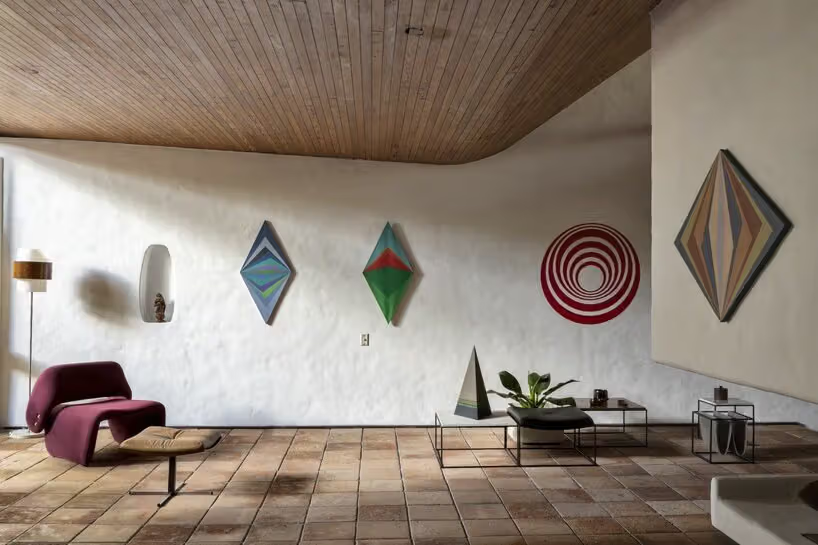
The house itself is a microcosm of his life story: the ceiling is made of Riga pine, common in Eastern Europe, while the floor is laid with Brazil's famous rosewood—two materials from two different origins, in dialogue within a single space. The use of colored tiles carries hints of Nordic architecture, echoing techniques seen in Lina Bo Bardi's Glass House. Carmona says preserving this house isn't just about honoring one man—"it's about keeping alive the living scene of São Paulo's 1960s modernist lifestyle."
The retrospective exhibition "Warsaw – São Paulo – Milan. Jorge Zalszupin's Brazilian Modernism" will be held at Torre Velasca in Milan from April 20 to 24, 2026, curated and designed by Maria Murawsky. The exhibition's title itself maps out his life's journey: starting in Warsaw, settling in São Paulo, and finally being rediscovered by Europe.